Be yourself; Everyone else is already taken.
— Oscar Wilde.
This is the first post on my new blog. I’m just getting this new blog going, so stay tuned for more. Subscribe below to get notified when I post new updates.
Be yourself; Everyone else is already taken.
— Oscar Wilde.
This is the first post on my new blog. I’m just getting this new blog going, so stay tuned for more. Subscribe below to get notified when I post new updates.
Unofficial translation of https://www.pcmaoiste.org/actunationale/une-etincelle-peut-embraser-le-pays/

A single spark can start a prairie fire!
Last November 17th was the very first day of national deadlocking “against the rise in taxes”. The reports from our comrades, present on the pickets, blockades and in the assemblies were unanimous: the working-class presence was hegemonic, social revindications burst forth all over, and fury to attain victory mixed together with an explosive enthusiasm. The first leaders of the movement, those most heard, were overwhelmingly workers, came from the ranks of the popular masses, unaffiliated to any of the bourgeois parties. It was the popular masses and the workers who, driven by the will to struggle and to win, organized themselves locally despite all the obstacles (reactionary hegemony, absence of working-class organization, etc).
The following three weeks saw the great convergence and movement of the masses from the roadblocks towards the bourgeois city centres, where the police would become overwhelmed, where the Champs Elysées themselves were looted. Hundreds of thousands of people gathered together each day, right in the middle of winter. Near Bordeaux, in the Médoc region, one of the poorest regions in France, circa 3,000 people held a toll-booth night and day. Just like in many other cases, the eviction didn’t go smoothly, and the toll-booth was partially burnt down. Even in Belgium, the violence of the masses and self-organization responded to the violence of the reforms of the Macron government. In the colony of Reunion, things became practically insurrectional. Within a few weeks, the bourgeoisie would bear witness to the working class becoming audacious once again. We shall attempt to analyse this movement in order to draw conclusions in preparation for December 5th of this year and its aftermath, which looks very likely to be explosive.
Indeed, the main logistical sectors are seeing an increase in calls for an indefinite general strike: SNCF (French National Railway Company), RATP (Autonomous Parisian Transportation Administration), truck hauliers, bus drivers, airport ground crews, etc…
The unions are obliged to play it “tough” in the face of the rage of the masses, but it may well happen that the movement once again slips beyond any control. This December 5th is becoming a prospect that the date of November 16th must make even more obvious. Thus, based on the lessons of the yellow vest movement, we must prepare for a new mass movement.
This indefinite strike is taking place just one year after the great explosion of the 17th of November. The masses, without any experience nor organization, have proven their heroic courage. After decades of defeat, without an organizational culture, without any overall, overarching vision, a significant part of the working class decided to take matters into their own hands, particularly in the rural and suburban zones, where the petit-bourgeois left and its organizations have no presence. The unions themselves were received ambivalently: on the one hand, rejection of the confederations and their numerous betrayals, on the other, most prominently, numerous examples of grassroots involvement of local union worker activists in the mass movements since the beginning. Since the start of November, general assemblies, highway blockages, demonstrations by foot and by car, etc, all multiplied. The matter of the fuel taxes opened the path to the high cost of living and the question: who controls the State? Who benefits from the current setup of society? Why must we work to survive while others live lavishly upon our work, our misery? Why is it that left-wing organizations preach non-violence while it is only violence that works?
The Gilet Jaunes movement posed the same questions that our ideological line, Marxism-Leninism-Maoism poses, and which our Party applies to the concrete politics of the French State. The violence of the unorganized masses against the State greatly surpassed the traditional spectacular demonstrations. The striking images such as the burning of the prefecture of Le Puy-en-Velay, of the Narbonne tollbooths, the looting of the Champs-Elysées or indeed Christophe Dettinger’s hand-to-hand fight against the CRS (Republican Security Companies, riot police) are only a few examples; but all over, we have seen proletarians taking on the police, sometimes armed only with stones, sticks and shields, with their faces uncovered, often even with their bare hands. The proletariat has once again proven the correctness of the theory of Marx, demonstrating that it is the only class which is thoroughly and completely revolutionary.
A huge part of the Left demonstrated their liquidationism, in trying to halt and put an end to a movement which belonged to a class that was not theirs. From the very beginning, the Gilet Jaunes (“Yellow Vests”) were described as fascists or simply not joined up with, even if they were supported with half-hearted words. Because our society finds itself under a reactionary hegemony, no class movement can be pure. Ever since the very beginning of the movement, our Party has made this analysis, choosing to study the movement from within, perceiving the contradictions and potentialities which existed therein. Our young organization has strengthened itself in this struggle, learning decisive lessons from the popular masses, from their ability to raise the question of power from the very first instant, to discuss the State, to discuss violent and even armed struggle.
We present here a first self-criticism to the proletariat in stressing that our Party in reconstitution and reconstruction could but insufficiently synthesize the ideas of the masses to a higher level, avoid the tendency for tailism and directly lead the blockages and actions of the shock-troops of our Class. We could have reorganized roadblocks instead of shutting ourselves up in the cities, reorganized the car-based demonstrations which were so popular, could have organized security detachments to fight the cops, organized the violence of the masses against corrupt politicians, against the most hated bosses, against temp agencies or real estate agencies. Our work has been too fragmented and insufficiently proactive, insufficiently meticulous. But, what we have learned and corrected through forging ourselves in this movement; on the necessity of the political leadership of the Party, on revolutionary violence, protracted struggle – these are all lessons of an inestimable value for the reconstruction of the Party for People’s War here, in the French State.
Today, the climate remains very tense due to the anti-masses reforms of the Macron government; the reduction in unemployment (around 50% of the unemployed will lose between 25% and 100% of their allowance), the upcoming pension reform, the announced reform of night work in distribution, or even the introduction of the “one-time allowance”, the devastation of the hospitals and the privatization of State services – increasing the cost for the masses – as well as the increase in the cost of living and of taxes, are causing, and will continue to cause poverty to soar and render daily life unbearable. Attacks against the masses are increasingly violent and direct, with the aim of anesthetizing the masses, to prevent any counter-attacks.
In this context, the Gilet Jaunes movement was a spark against the government of the imperialist bourgeoisie, which was forced to deploy a huge police and judicial arsenal, more repressive than ever before. More than 3,000 yellow vests have been convicted and 1,000 have been imprisoned; the popularity of the police and the judiciary is in free-fall. Repressive laws are in place, demonstrations are systematically attacked. The bosses strongly repressed the most enthusiastic yellow vests in many companies. Several activists are in prison for their militant involvement in the Gilet Jaunes movement, and we must strive to build a great and strong Red Aid, to be ready to support the popular masses in the movements which will surely come.
Meanwhile, the State continues to strike the iron for the fascists, by increasing the power of the repressive arsenal, but also through encouraging media coverage of the most reactionary theorists, by taking up the anti-immigrant discourse of the National Front (with the near-confessed aim of diverting anger from the social question). The State is preparing for contemporary fascism through these transformations which allow the fascist party to strengthen itself, it increasingly embraces corruption, reinforces individualism and continues to destroy the social and community fabric. The reformist and even “”revolutionary”” left is absolutely not up to the task: who, in these days, apart from the Communists, is preparing to take on a fascist regime? Who can claim to be building an organization strong enough to resist repression? For that matter, who is it that is confronted with the ordeal of repression and imprisonment? The present-day left is pathetic and we should not expect our salvation to come from anyone except ourselves.
Therefore, we need to reinforce our organisation. In order to do this, we must first place ourselves at the service of the people, we must learn from the masses. In struggles, as we have seen, it is the masses who educate us, so that we may become educators. Our role, as Maoists, is to construct the Communist Party and its political line by synthesizing the correct ideas and discarding the incorrect ideas. But these do not emerge from our own heads! We must learn them from the masses, then test them, prove them in practice, and then finally, in a dialectical process, turn them into the guiding lines of our organisations, gather the masses around these organizations, organize them, so as to give them the tools of resistance and revolution. Without learning from the masses, without learning methods of struggle, we cannot synthesize whatsoever. We have learned from the Gilet Jaunes, and we must continue to learn.
This learning is not tailism, it is the conscious immersion of the advanced elements of the proletariat within the popular masses and their struggles, in order to grasp all struggles and make itself capable of leading by extending our mass base. At the same time, in a dialectical manner, we must build the United Front, develop our workers’ front, but also our youth, womens’ and LGBTI organizations. It is through taking the initiative and going against the current that we shall forge ourselves as Communists, members of the Party of our class.
Without succeeding in this task which is central to the construction of the Party, we cannot build the three instruments of the revolution. By putting ourselves at the service of the masses, by synthesizing the correct ideas and elevating them to a higher level, through practice and theoretical study (meaning the study of past practice throughout the world), we become the advanced fraction of the working class, we merge the Party and the vanguard of the class, we turn the subjective vanguard of the class (as the most radical working-class section of the Gilet Jaunes was) into an objective vanguard, a vanguard that seeks to make revolution and gives itself the means to do so.
On December 5th, a new detonation will take place. It could possibly set the whole prairie ablaze. Our comrades in the revolutionary organizations and in the Party must study the example of the Gilet Jaunes movement and take the initiative. We must organize pickets, demonstrations, blockages, construct the Party and the Front in the fires of the class struggle. Let us make December 2019 a key date in the construction of the party, on the path of the revolution!
On the International Situation
Originally published 14th January 2014
by Peru People’s Movement – Reorganization Committee
UNDERSTANDING BUREAUCRATIC CAPITALISM IS ESSENTIAL TO DEMOCRATIC REVOLUTION
In discussing bureaucratic capitalism, as upholders of Marxism-Leninism-Maoism, Gonzalo Thought, we start from the principal economic characteristic of imperialism, namely that it is parasitic and decaying monopoly capitalism. According to Lenin1: “the deepest economic foundation of imperialism is monopoly“ which has been generated by finance capital, “…firstly the monopoly associations divide the home market, then divide the world market directly with eachother and among a handful of imperialist countries”.
In this regard, the most diverse representatives of imperialism and its revisionist servants, attempting to hide the economic essence of the development of the world economy, in the most differing forms unceasingly repeat the imperialist propaganda about the benefits of “globalization” and therefore of the “liberalization of the markets, of world trade and foreign investment” for the “developing countries” (as they call the oppressed or Third World countries). They ponder much about the growth in participation of the “emerging countries” in world trade, a growth that has culminated in the long recession suffered by the world economy, ongoing since 2008, more than five years. What has been hidden are the facts of who truly benefited from the past growth, their nature, and that said growth of trade in “emerging countries” was driven by the struggle between the “monopoly associations” for markets through the export of capital under different forms, and which in not a single case has meant a step forward in the solution to the exploitation and backwardness suffered by the Third World through imperialist oppression, semi-feudalism and bureaucratic capitalism. In Peru, the rats of the right opportunist line, revisionist and capitulationist (ROL) say that Peruvian society is now capitalist. Therefore, as we will see further on, we have global growth, including commerce from the oppressed countries, driven by the growth of imperialist capital export: by greater financial speculation and interbank loans, investment funds and by the so-called foreign direct investment (FDI) of the great monopolists, as well as through the other forms of imperialist capital penetration in the struggle for “economic territory” (markets) as much in the imperialist countries (by the law of uneven development) as in the oppressed countries (by the market for finance capital, for the export of their commodities, for the sources of raw materials and for cheap labor).
Among the other forms of investment are licenses and all other manner of the transfer of intangible or tangible assets from foreign companies to the companies in the oppressed countries, because it is also in this way that they establish the bonds of subjugation, and in this manner they accede to the internal market (the so-called “vertical integration” of the imperialist monopolies, or “global value chains” are other forms of association of the imperialist monopolies with the monopolies in the countries of bureaucratic capitalism, monopolies which they themselves have generated). In balance sheets they appear as “patrimonial payment to abroad”, by technological transfer, for the payment of licenses and royalties. They do not appear as investment earnings or direct reinvestment.
Likewise, imperialist capital investment through “aid” should not be forgotten (the “development aid”, which, for example, the German State officially considers as an indispensable way to promote the export of its capital and commodities). Hence, this “growth” implies greater backwardness and greater oppression and violence for the oppressed countries. The data is unambiguous, from 1990-2008, world trade grew more than world GDP. Why? Because much of this growth corresponded to the trade of parts or inputs for the final production which was carried out within the so-called transnational or multinational enterprises (TNEs/MNEs) which extend their tentacles throughout the world, or as bourgeois academics would say, “are vertically structured on the international level” in the so-called “global valorization chains” (GVC). The OECD itself and other international organizations of imperialism say that this growth has been driven in our countries by foreign direct investment (FDI) through the MNEs.2
This expresses further development of the accumulation of finance capital, of the concentration and centralization of capital by the great imperialist monopolies, by the financial oligarchy. Therefore, further development of the “holding system” (Lenin) through the export of capital in the form of FDI to create subsidiaries abroad, of which the most typical expression is the “sweatshop“, or assembly floor of the final product (output).
We cannot allow them to come to us with their fairytale of “the new international division of labor”, where all countries are supposedly integrated into a single production system. The imperialists contradict themselves, as in the report of the OECD, WTO (World Trade Organization) and others, which we cited earlier, where it is written that the creation of a single “global production network” is a “pending task of high importance”3
We crush and reject what the ROL says, because it is contrary to Marxism and to reality in claiming that what is happening in our countries is “primitive accumulation of capital” as if imperialism, which oppresses us more and more and finds itself in full collapse, would allow individual and independent capitalist development in our countries.
The dispossession of the peasantry and other working masses of our countries does not serve for the accumulation of money, means of production and life and labor force in the hands of a nascent national bourgeois class, middle and small bourgeoisie, but the greater accumulation and centralization of capital in the hands of the imperialist financial bourgeoisie and a handful of bloodsuckers of bureaucratic, comprador and feudal capital.
The immense pauperized mass, stripped of everything, finds no employment and is becoming overcrowded in the cities and increasingly expresses itself as part of the growing and unstoppable increase in crime and vagrancy in Third World countries. All this is a product of the three mountains that oppress our people and impede the development of our countries. This supposed “primitive accumulation” of the ROL, therefore, is only revisionist poison to justify their capitulation to imperialism and Peruvian reaction, their abandonment of the people’s war waged to complete the democratic revolution.
As a consequence of the growth of world trade – “whose percentage significance in world GDP expanded, from an index of about 16% of the world’s gross product in 1990 (the year in which the percentage peak previously reached in 1913 was reached again, our note) to one of 27% of the world’s gross product in 2008, the year before the full impact of the crisis on world trade, which occurred in 2009”.4 – these monopolistic associations, of which Lenin speaks, were in reality the big winners, not the oppressed countries.
These imperialist monopoly associations, MNEs, have redivided the world up amongst themselves. These, at the world scale between 1990 and 2008 “increased their sales from USD$6 trillion to more than $31 trillion, that is to say an over 5x increase.” The MNEs had a capital increase of 1100%, namely circa $72 trillion in 2008, and employed almost 72 million workers”, according to the 2010 World Investment Report of the UNCTAD5. This report estimates that “the 500 biggest multinationals now have a participation rate of circa 70% in world commerce”.
Thus, it is the grand monopolists, these MNEs, who, through their investments, directly divide up among themselves the sales and profits of world trade. These MNEs belong to a handful of imperialist countries, such as the United States, Japan, Germany, France, England, China, Italy, Russia, the Netherlands, Sweden, Switzerland, etc. These are the ones who benefit from the biggest share of the pie, as we will see when we deal with the economic base of the imperialist conflict.
Do not come to us with cheap generalizations about “emerging countries.” There are no such countries, the only countries that exist today are subdivided into a handful of oppressor countries, and the oppressed countries which constitute the vast majority.
The domination of the monopoly associations and imperialist countries over the oppressed countries has intensified
The struggle between monopolies and a handful of countries for the territorial division of the world has become increasingly acute since World War II. These aforementioned two have been increasingly penetrating the economies of the oppressed countries or the “Third World”.
Although most – not all – of the Third World countries were conquering their independence from colonial rule after World War II, this only signified their transition to being politically independent countries with formal sovereignty. In short, the economy of these countries remained within the world picture as colonial economies, meaning they are subject to the world market which the imperialist countries exercise monopoly dominance over; that is to say, it is subject to their interests and needs.
In economic terms, the socio-economic formation of the colonial era was maintained, the democratic revolution was not carried through to the end because, in most cases, this revolution was not led by the Communist Party. Because the bourgeoisie is historically unable to carry it out and also, because in our countries there is no (and it could not have formed itself) strong national bourgeoisie that would be the “boss of the country’s economic life” (Mariátegui). Consequently, both the national question and the democratic question still await a solution. It is for this reason that the grand intermediary bourgeoisie, subservient to the interests of landlords and imperialism, was the class that assumed power in these countries. Thereafter the oppressed countries went from being colonial to semi-colonial, where bureaucratic capitalism develops on the semi-feudal base, as we will see here when we deal with the countries of Southeast Asia.
In many cases they pass from being dominated by the particular colonial power to being dominated in the main by another imperialist country; in many others, the old colonial power becomes the imperialist power that principally dominates in the newly independent country. This is not a question of, as some claim, “new forms of colonialism” or “neo-colonialism“. The inter-imperialist struggle expresses itself through loans, aid, technology transfer, FDI, etc. plus international organizations at the service of imperialism such as the IMF, the World Bank, the IADB, USAID, CARITAS, NGOs, the OECD, UNTAC, WTO, etc, or as proxy wars.
The expansion of monopolistic associations in the Third World shows how the development of imperialist capital penetration has been going. Worldwide, the growth of the subsidiaries of the parent company monopolies has been very rapid, thus between 1946 and 1961, 3,550 new subsidiaries (daughter companies) were founded, and, according to UN data, in the 1961-1996 period, 260,000 were created, as stated in an inquiry by Kurt Hübner 6, where the following conclusion is reached: “While the developed capitalist economies represent the headquarters of the business centers, the economies of the Third World, and also those of Central and Eastern Europe, take on the function of the headquarters of the subsidiaries.“
Thus, the capitalism generated by imperialism in our countries is a capitalism which is subject to their interests and therefore prevents true national development, that is to say, it is bureaucratic capitalism.
Regarding the dominance which the imperialist countries exercise over the oppressed countries (colonial and semicolonial), Lenin said: “Theimperialismofthe beginning of the 20th century completedthedivisionof the world among a handful of states, each of which today exploits (in the sense of drawing superprofits from) a part of the “whole world” only a little smaller than that which England exploited in 1858; each of them occupies a monopoly position in the world market thanks to trusts, cartels, finance capital and creditor and debtor relations; each of them enjoys to some degree a colonial monopoly”7
This is the economic essence of the question, the imperialist countries draw superprofits from the oppressed countries, over which each of them exercises or “enjoys to some degree a colonial monopoly” despite the political independence or formal sovereignty of a great deal of them. That is the similarity that Lenin establishes between the colonialism of the phase of capitalism characterized by free competition, with colonialism in the phase of imperialism.
Maoism does not speak of “neo-colonialism”, as some do, arguing that the CCP established it in one of the letters of the “Great Polemic”, in “[Against the] Apologists of Neocolonialism”. Yes, but it wasn’t Chairman Mao who used that term. In addition, within said document they denounce Khrushchevite revisionism which was trying to deny the existence of the colonial problem and imperialist oppression over most countries of the world, therefore denying the necessity for the Communists to lead the national liberation movement. Those who attempt to utilize this term as a legitimately Maoist term, do so to oppose the economic essence of the issue and deny the need for democratic revolution through people’s war. We will return to this topic later.
Therefore, let’s briefly look at how the imperialists implement their plans to maintain the oppression of the Third World countries and struggle amongst themselves for hegemony. Let’s take a brief look at the history of economic development, so far as it corresponds to the oppressed countries, especially in the following area of the world, Asia. Because, when the conditions are met, with the anti-communist coup carried out by Deng’s revisionism in China, what Yankee imperialism does, is expand the application of the hegemonist economic plan which it had been implementing in order to intensify the restoration in China.
The worldwide hegemonist and counter-revolutionary plan of Yankee imperialism
Yankee imperialism, which emerges from the Second World War as a hegemonic imperialist power, pushes forward the landowners’ path in agriculture in the backward countries to serve for greater penetration of their capital in the countryside, by means of the specific conditions in each country. This evolutionary path means new modalities of concentration of the old landlords’ properties and, therefore, the sustenance of serfdom under new forms. In order to do this: First, in the 1950s Yankee imperialism launched its so-called “green revolution“; they deployed their “technicians” to various countries to propagate in these countries the benefits of its plan and promoted the creation of agricultural offices and their “agricultural clubs” for young peasants; then, they would promote successive agrarian laws through governments, pompously labeled “agrarian reform”; but which were in fact only agrarian measures to promote the path of the landlords in the countryside. So the problem of the land – expressed in the existence of the latifundios and of servitude under new forms – persists, with the result that the exploitation and destitution of the immense mass of peasants in the world has been strengthened and renewed.
1. The three lines of development of bureaucratic capitalism in Latin America, the three necessities and the three reactionary tasks
In 1972, the Red Fraction of the PCP led by Chairman Gonzalo disseminated the “Analysis of the 1971-75 National Plan of Development” of the contemporary fascist military government, through the Popular Information Centre which published “People’s Voice”, in which a clear position was established against this imperialist plan, and we quote: “The Program of the Alliance for Progress (“Carta del Punta del Este”, our note) signified an important turn in this process for Peru and for Latin America, which in view of the repercussions of the Cuban Revolution, proposed the restructuring of Latin American society as a preventive measure against the anticipated revolutionary outbursts. It is important to recall the proposals of this Alliance to understand the process that the country is undergoing.
The “Carta de Punta del Este” proposed the association of the American republics for “faster economic progress and wider social justice for their peoples, respecting the dignity of man and political freedom”, in its preamble; and, in its stipulated developmental objectives outlined “that the resources dedicated to investment would represent a greater portion of the national product”; it also proposed: “the acceleration of the process of rational industrialization to increase the overall productivity of the economy, fully utilizing the capacity and services of both the private and public sectors, within this industrialization process, special attention would be paid to the establishment and development of industries producing capital goods”, On the agrarian question they proposed: “to promote within the particularities of each country, programs of integral agrarian reform oriented to the effective transformation of the structures and unjust systems of tenure and exploitation of the land where it is required, with a view to replacing the latifundio and minifundio regime for a fair property system,…” and establish “peasant cooperatives and associations and community development programs”. And about education: “Eliminate illiteracy..; modernize and expand the means for secondary, technical and higher education; increase the capacity for pure and applied research, and foster the trained personnel required by rapidly developing societies” (Emphasis ours, that is to say, by “People’s Voice”).
Finally, on economic integration, it proposed: “to expand the current Latin American national markets, as an indispensable condition to accelerate the process of economic development on the continent and as an adequate way of obtaining greater productivity through industrial specialization and complementation, …This expansion of the markets will allow a better use of resources proposed in the Alliance for Progress”. As is clear from the quotation of “People’s Voice” regarding the “Carta de Punta del Este”, this counterrevolutionary and hegemonist plan tried to ward off the revolution, seeking to eliminate its peasant base through its agrarian measures, “agrarian reform programs”, that is to say, their so-called “agrarian reform laws“, whose character and results are clear; whose economic objectives were to further boost the penetration of its capitals in the Latin American countryside and, as established there for its semi-colonies, the necessity to “accelerate the process of a rational industrialization (…) especially regarding the establishment and development of of capital goods producing industries” to try to foster in the oppressed countries like those in Latin America, a dependent industrialization which, consequently, would be subject to their interests (bureaucratic capitalism).
In the part referred to regarding economic integration, the necessity for imperialism to develop “industrial complementation and specialization” and economies of scale for the greater export of capital and commodities, through the establishment of its subsidiary or “related” companies (parent, multinational or transnational enterprises (MNEs or TNEs) in the imperialist countries, and subsidiary companies: daughters, granddaughters, etc, in the oppressed countries) is clearly established – this all would later become known as “global value chains” “global production networks” or “international fragmentation of production”.
This is the greatest form of dominance of the imperialist monopolies over the oppressed countries, which has been facilitated more with the free trade agreements and common markets, and which is expressed in the increase of intra-regional trade – among the MERCOSUR countries, for example – and this, therefore, is not an expression of the economic development of these countries, but instead of that capitalism which is subject to imperialism, which corresponds to its necessity to struggle for external markets, driven by the crisis of the imperialist system itself and of Yankee imperialism in particular, a crisis that has been increasing since the late 1960s, and of which, all its contradictions are sharpening.
Consequently, the tribute which finance capital extracts from its companies in its colonies, semicolonies and overseas countries grows, as Lenin had already observed at the beginning of the last century with respect to Japan. As a consequence of the sharpening of the contradictions of imperialism, “towards the end of the 1960s and the following years, Yankee imperialism started to run into trouble and, on the other hand, in the Latin American countries the industrial and financial plan failed and entered thereafter into reassessment. (“People’s Voice”, in the article cited previously)”.
In the quotes from the “Carta de Punta del Este”, the three lines of development of bureaucratic capitalism in agriculture, industry, commerce and finance and in education are established. Then, in the latter part of the 1960s and the start of the 1970s, Yankee imperialism specified the three reactionary tasks for the reactionary governments of the Continent, which responded to the three needs of imperialism: deepen the development of bureaucratic capitalism, restructure the bureaucrat-landlord state and prevent revolution. Later, in the 1980s, bureaucratic capitalism in Perú entered its general crisis and sweeping away by the People’s War, and Yankee imperialism specified that they should: reinvigorate bureaucratic capitalism, restructure the bureaucrat-landlord State and annihilate the People’s War. As the Party has established, the completion of these tasks is a political and historical impossibility.
This is very important to be able have a historical vision of what is happening and to understand what is going on in the world, especially in the oppressed countries. The economic relations in the epoch of imperialism on the basis of the division of the world between imperialist and oppressed countries (political economy) and the economic measures (economic policy). Look at how in the face of the biggest crisis of imperialism, from the early 1970s onwards they started to change their predominantly Keynesian economic policy for that of a stale “monetarism” and “neoliberalism” and began to push through privatizations.
It is necessary to take into account the readjustments and the reconsiderations of the plans of imperialism, which arise in the new international conditions and above all accord with the concrete conditions of the economic process of bureaucratic capitalism in each country and their experiences in class struggle and political outlooks, as Chairman Gonzalo teaches us. He also tells us that we must always see who is served by such-and-such proposal, plan, or measure. In this case, it served and was within the plans of world domination of Yankee imperialism and served also the native exploiting classes.
2. In Asia: the plan of Yankee imperialism, the dispute for the oppressed countries, and the fomentation of restoration in China
Pursuing its world plan in Asia, Yankee imperialism pushed forward with its hegemonist and counter-revolutionary world plan, increasing the exportation of its capital from the mid-1960s onwards. The other imperialists such as Japan, etc, tried to do the same. This expresses the inter-imperialist dispute over the semi-colonial countries in Asia and the taking up of positions as far back as that time, while seeking also to gain influence through revisionism and actively watching ongoing events in China, where the Great Proletarian Cultural Revolution was developing powerfully, or in other words – the struggle to remain on the socialist path instead of passing to the bourgeois path of restoration. Imperialism, reaction and revisionism colluded with the aim to do away with the socialist revolution and the dictatorship of the proletariat in China, a great base of support for the World Revolution. With Deng’s anti-communist revisionist coup in 1976, China became a large potential market for the overseas enterprises of finance capital, which were strategically located, seeking to gain super-profits through the export of capital.
The exportation of imperialist finance capital as FDI takes greater importance
As Lenin said, commodity production continues to be the basis of the economy in the epoch of imperialism, but it is already rotten, since finance capital seeks its realization where it can reach higher rates of profit, namely by overseas investments, investments abroad, as the crisis of imperialism progresses, the struggle for economic territory, markets and sources of raw materials becomes sharper, mainly for the semi-colonial countries. As a result, the export of capital is increasing and FDI has been taking greater importance since the mid 1960s, which means intensification of the third contradiction (inter-imperialist) and especially the principal contradiction – namely that between the oppressed countries on one hand and the imperialist countries (powers and superpowers) on the other.
FDI is done as a “package” as we will see, by way of example, when we deal with the case of Taiwan – that is to say, it is the principal form that the importation of “productive capital” for the oppressed countries takes (if FDI is seen from the perspective of these countries), which generates a greater deformation of its productive structure, since practically the only thing that will grow is that which is related to the needs of the world market.
When these needs change – for economic as well as extra-economic reasons – what they leave behind is thousands suddenly unemployed, ghost towns, abandoned mineshafts, trash of all kinds – that is to say consequences which bear a high social and economic cost as well a high cost for the resources of the country, and “more need” for imperialist capital to commence anew and end in the same way. This is the vicious circle of imperialist domination: the maintenance of third-world countries as colonial or semi-colonial and semi-feudal countries where bureaucratic capitalism develops.
Through this FDI package, the imperialist monopolies increase the export of their commodities as “inputs for the production” of the “final product”. In the majority of cases, these “inputs” represent the total of the parts required to do, in the FDI receptor country, solely the assembly – or furthermore in many cases only the packaging. This is how it goes generally, this is what the bourgeois economists call “international fragmentation of production”, “new international division of labor”, etc.
But now, let’s see, through a study published by the Australian National University in November 2009, and afterwards as a book: “The Rise of Asia, Trade and Investment in Global Perspective”, edited by Prema-chandra Athukorala, Editorial Selection 2010, Pg.31 onwards, where very important information is reflected regarding the economic development of Southeast Asia, how the development of imperialist investment took place in this part of the world:
“International production fragmentation has become one of the defining characteristics of world trade over the past few decades. The electronics MNEs based in the USA started the process in the late 1960s in response to increasing pressures of domestic real-wage increases and rising import competition from low-cost sources. The U.S. government facilitated the process by introducing an external processing tariff (“Outward Processing Tariff”, (OPT)), whereby businesses were authorized to export material to be processed overseas and then reimport the final product, paying fees only on the value aggregated overseas (not on the intermediate exported goods). Geography, costs and history all combined to persuade the American MNEs to explore overseas production opportunities in the neighboring countries of Latin America. However, unfavourable investment climate in these countries – macroeconomic instability, political tensions, trade union upheavals and uncertainty – led American producers to switch to sub-suppliers located in East Asia (Helleiner 1973, Grunwald and Flamm 1985, Feenstra 1998, Brown and Linden 2005)”.
Thus, this is linked to what was seen earlier about the “Carta de Punta del Este” and as such also with the rivalry between monopolies and between imperialist countries for the dominance of “overseas economic territory” to obtain “imperialist super-profits”, as can be deduced from the following quotation:
“The preference of the global electronics production networks for Southeast Asia began in 1968 with the arrival of two US companies, National Semiconductors and Texas Instruments, to set up plants in Singapore to assemble semiconductor devices. By the beginning of the 1970s Singapore had the lion’s share of offshore assembly activities of the US and European semiconductor industries. Virtually every international electronics producer was present in Singapore by the mid 1980s, when the hard disk drive (HDD) assemblers entered the country, further boosting its role as a global assembly centre (see Chapter 4 in this volume). During the next five years semiconductor production declined in relative importance, and computer peripherals, especially hard disk drives and computers, became the more important part of the island’s electronic industry. By the 1980s, Singapore was the world’s largest exporter of hard drives, representing almost half of all global production. (McKendrick et al, 2000)”.
Very clear, in the beginning it was the Yankee electronics monopolies, later on all of the international monopolies of this branch were present there, disputing their share of the pie, and after, they extended out to the other countries as can be read below:
“From 1972, the MNEs with production facilities in Singapore began to relocate some low-end assembly activities to neighbouring countries (particularly Malaysia, Thailand and the Philippines) in response to the rapid growth of wages and land prices. Many newcomer MNEs to the region also set up production bases in these countries, bypassing Singapore. By the late 1980s, this process had created a new regional division of labour, based on skill differences involved in different stages of the production process and relative wages, and improved communication and transport infrastructure. At the time, there was widespread concern in Singaporean political circles (…) However (…) the electronics industry (…) needs a large number of heterogeneous components in its manufacturing in Southeast Asia , also greater economies of scale and more possibilities for specialization for all participating countries. More recently, regional production networks have begun to expand to Vietnam (…2007). Despite obvious advantages in terms of location and relative wages, Indonesia has so far failed to benefit from this new form of international specialization due to its unfavorable internal investment climate (… 2006)”.
As can be seen, imperialist capital goes to the oppressed countries to conquer markets for their investments and commodities, to dominate the sources of raw materials and to exploit cheap labor, in other words, to thus stay ahead of their competitors in the struggle for world domination. In this region of the world, the study says:
“A number of factors underpin the continued attraction of the region as a place for assembly activities. Firstly, despite rapid growth, manufacturing wages in all ASEAN countries, except Singapore, remain lower or comparable to those in the European periphery countries and Mexico (…) Secondly, the relative cost advantage factor has been complemented by trade which is relatively more favorable, investment policy arrangements and better ports and communication systems to facilitate trade by reducing maintenance costs of “service links” ( which means that everything is subject to FDI, our note) (…) The site selection decisions of multinational companies operating in assembly activities are greatly influenced by the presence of other key players in the market in a given country or neighboring countries. In the context of a long period of successful operation in the region, many of the multinational companies (particularly those based in the United States) have significantly improved the technical activities of their ASEAN regional production networks and have assigned global production responsibilities to subsidiaries located in Singapore and more recently to those found in Malaysia and Thailand) (Borrus et al., 2000; McKendrick et al., 2000)
In general, the experience of the ASEAN region seems to support the view that subsidiaries of multinational companies have a tendency to become increasingly embedded in host countries, are present there longer and eventually the global investment climate of the host country becomes more favorable. (Rangan and Lawrence, 1999; Athukorala and Yamashita, 2006). Over the years, Singapore’s role in regional production networks has gradually changed, from assembly of low-skill components and testing for the manufacture & design of components and provisioning, to serving as the headquarters of production unit services located in neighboring countries. The appeal of Singapore, as a regional center for cross-border production networks, has continuously improved by the emphasis of government policy on the development of infrastructure, expanding the human capital base, maintaining labor relations in a manner very favorable for international production, and macro-economic management.” (McKendrick et al., 2000; Brown and Linden, 2005)”.
The quote above expresses that the State should provide everything to imperialist finance capital, that it is at the service of imperialism. It demonstrates the semi-colonial character of each and every one of these countries; the State must provide all the infrastructure for foreign investment and for the native grand bourgeoisie and the landlords, must provide healthcare, education, social services, etc., all in order to ensure that labour power is reproduced at the lowest price possible, along with contractual security and all other types of security; the government must ensure low wages, long hours and bad working conditions, as well as taking care to increase the international reserves of the country so as to guarantee the investment and return of foreign capital profit, etc. This all relates to the “liberalization” of production, trade, finance and labour power. Liberalization does not mean that a reduction in size of the State occurs – quite the contrary – it means that state sovereignty is extended for some (the imperialist countries) and is reduced for others (the Third World countries).
Continuing on, the study says: “The data (…) helps to understand the growing importance of the trade in parts and components for world trade in machinery and transport equipment and the central role played by Southeast Asian countries in this trade. World trade in parts and components increased from about 20.9% of total manufacturing exports in 1992/93 to 24.2% in 2004/05 (Trade in parts and components accounted for almost one third of the total increase in world manufacturing exports between these two years). In the development of East Asia, all the countries included in the table have recorded increases in world market shares, with the six Southeast Asian countries growing faster than the regional average. In East Asia, the ASEAN countries, particularly Malaysia, Thailand, the Philippines and Singapore, stand out for their high dependence on export dynamism and product fragmentation. In 2004/5, component trade made up 58.4% of the total exports from Southeast Asian countries, up from 46.7% in 1992/3.”
In conclusion, upon the basis of a semi-colonial and semi-feudal economy in these Southeast Asian countries, the necessity of imperialism to export commodities and capital, as well as its need for cheap labor and raw materials, has fostered the development of a bureaucratic capitalism.
THE COUNTRIES OF SOUTHEAST ASIA TRANSFORMED FROM COLONIES INTO SEMICOLONIES: IMCOMPLETED REVOLUTION
One must bear in mind that through the colonial expansion of the European countries, the economies of Southeast Asia “since the middle of the 19th century” found themselves involved in the “expansion of the capitalist world system”, as stated in a report by Hans-Dieter Eve (which we have chosen to serve as a contrast, being a source of a different kind).8 That is to say, they became colonial countries and their process of slow evolution to capitalism (semi-feudalism) commenced. In the same report, we read: “In 1920, imports and exports accounted for over 50% of the colonial gross product of the Dutch East Indies and a similar figure can be cited for the State of Malaysia (…) The change from subsistence production to market-oriented production, the extension of agricultural credit and the growth of international trade characterizes Southeast Asia from the mid-19th century onwards (Evers 1978). The question is: where do the benefits of this increased productivity and enhanced farm income go? A large part is of course transferred to the colonial motherland and contributes to the industrialization of the West, part of the profit is channeled back to Southeast Asia in terms of foreign investment; but, part of it is appropriated by the local strategic groups (the grand bourgeoisie in formation, our note) which is growing and is seeking a greater portion of this surplus product.”9
In brief, we quote from this “work document” because despite the class limitations of academics such as this one, it demonstrates that with the establishment of the colonial economy “new groups emerge based on the new sources of income”10, “which seek to establish a superstructure (…) that is more suited to their interests” which are called “strategic groups”, which for us are nothing other than the factions of the native grand bourgeoisie in Southeast Asia.
After the Second World War and with the conquest of independence, colonial and semi-feudal society would transform into semi-colonial and semi-feudal society, upon which bureaucratic capitalism develops, which the author of the paper refers to as the development of “colonial capitalism” in Southeast Asia.
It continues: “But, the restructuring of the economies of Southeast Asia, the change from subsistence agriculture to export-oriented production, and the dominant position attained by foreign investors, not to mention the European, Japanese and American military intervention, has changed life in Southeast Asia in the most remote villages, even if pre-colonial aspects of the socio-cultural structure are maintained”.11
This is significant! Because, despite its class limitations it demonstrates an objective fact, namely, that imperialism evolves feudalism and upon that base develops a capitalism tied to its interests (bureaucratic capitalism).
When these countries conquer their formal political independence, they remain economically tied to the imperialist economy, they remain within the framework of the world economy, as Mariátegui established for the Peruvian case, a colonial economy. It is for this reason that they become semi-colonial countries. There is no national or middle bourgeoisie in these countries which is sufficiently strong or robust enough to assume the role of the “boss of the national economy” (Mariategui).
Consequently, those who hold economic and political power in these newly independent countries are the grand bourgeoisie and the landlords in the service of imperialism. For this reason, they are countries that have political independence or formal sovereignty. In the era of imperialism and the proletarian revolution, the old bourgeois revolution is no longer possible, hence, the Prussian path can no longer lead to the development of capitalism, as it once did in Germany. As long as the proletariat and its Party with the people’s war based on the solid alliance with the peasantry does not complete the democratic revolution of a new type, our countries will retain their character indefinitely and imperialism will possess “to some degree a colonial monopoly“ within them.
Regarding the factions of the grand bourgeoisie, for example in the case of Indonesia, the document says: “The coup of 1965, and as a result of the massacre throughout the entire country, led to the establishment of a military regime and the resurgence of foreign economic interests (…) In 1975, the revenue of the Indonesian government came from a typical colonial production of raw materials. Import-export taxes, including oil revenues, constitute 76.7% of the national budget, business and personal income taxes constituted only 3% of the budget.”12
WHAT IS THE ECONOMIC HEART OF THE MATTER?
Thus, the economic heart of the matter is not that “imperialism is applying new forms of domination” because it has lost its colonies and that it is now Yankee “neo-colonialism” etc, but that the economic base from the time before these countries gained formal independence, has remained intact with very few changes and thus, with the political and military fact of independence they become semi-colonial countries while remaining semi-feudal and therefore, the capitalism which develops here, is bureaucratic capitalism at the service of imperialism, which holds in these countries “to some degree a colonial monopoly“. A certain economic policy corresponds to this economic base (under old or new forms), namely that which imperialism applies through the governments of these countries, where representatives of the two factions take turns to maintain their domination, to deepen and develop it. It is this way, and not the other way around.
In the final analysis, those who speak of the neo-colonial character of our countries, what they are proposing is that with a simple change of government the situation of our countries could be changed; this is nothing more than reformism and opportunism. This opportunistic concept of “neo-colonialism” is related to Kautsky’s opportunistic thesis of imperialism being “the preferred policy of finance capital“, which does not start from the economic essence of imperialism, which is to be monopolistic, parasitic and decaying capitalism, hence its reactionary and violent nature in economics, that is to say imperialist, and, therefore, reactionary and violent in politics, that is also imperialist in politics. The concept of a “neo-colony” does not start from the economic essence of the imperialist domination of our countries, which can be colonial or semi-colonial; but posits it instead as “forms of domination that imperialism applies“; meaning, as a policy of imperialism, at most as an economic policy. That is to say, with a simple change of government, the “national” problem could be solved.
THE “PARADIGMATIC” CASES OF SOUTH KOREA AND TAIWAN
It is also necessary to study the role of Japanese imperialism in this region (Southeast Asia) through Japanese FDI in South Korea and Taiwan.
DEVELOPMENT OF BUREAUCRATIC CAPITALISM IN SOUTH KOREA & THE ROLE OF IMPERIALISM
Korea was a Japanese colony from 1910 til 1945, that is to say until the defeat of Japan, and in 1952, after the defeat of Yankee imperialism in the Korean peninsula, the country was divided into North and South Korea. The full normalization of relations between South Korea and Japan took place in 1965.
In order to establish the role of Japan in South Korea we quote the following from a German academic:
“On the one hand, Japan, along with the USA, is the country’s most important trading partner and since the normalization of bilateral relations 30 years ago, also has the majority of foreign investment and has transferred more technology in the form of licences and capital goods. On the other hand, Japan’s development aid has played a non-negligible role in the implementation of South Korea’s economic development plans in general and for the construction of central industrial branches such as the steel industry in particular. Japanese businessmen have thus played a significant role in the Korean development process over the past three decades. South Korea was (together with Taiwan) a supplier for industrial branches, for which production in Japan was mainly due to costs, but also partly because they were no longer profitable due to the ever-increasing environmental demands or as a consequence of the restructuring process (…)
(…) To be able to see Japan’s role in the South Korean economy, one must visit Korean factories and establish where the machines with which production is undertaken come from, and where the components and basic materials come from, which are then incorporated into Korean products. Only after this can the central significance of Japan in sustaining the Korean economy be made clear. A key cause of Japan’s specific role in the South Korean economy stems from the rapid industrial development of South Korea, based on an industrial structure of pure assembly before an industrial country full of medium and small supplier industries could have developed. The weaknesses of small and medium enterprises (SMEs) in South Korea largely explains the country’s elevated dependence on imported technology, such as in the most important industries in the current phase of industrialization, like electronics and automobile manufacturing.”13
All this talk about the SMEs is, as the saying goes – the mental burden of the German academics, just as this Patrick Köllner has demonstrated – they separate them from the monopoly system in Germany, starting from the fact that they are all dependent on the German banks, organized according to the “holding system” (Lenin), which goes as far as the provincial banks or savings banks (Sparkassen), decentralization of the banking sector for a greater and broader centralization of the power of the grand German banks.
On the other hand, with regard to the development of production technology, SMEs, as suppliers of large industry, do so according to the rules and patents of the large companies that commission them to produce parts, whom they have to keep up to date as to what their profit margin is, according to a complaint from a German entrepreneur in the automotive parts branch. This is true in Germany as in any other imperialist country or in any oppressed country where bureaucratic capitalism is developed, that is, subject to imperialism, where the monopolies generated by finance capital dominate.
Development based on large monopoly enterprises and state intervention
With regard to the quoted study, it deals with the whole 30-year process of development of bureaucratic capitalism in South Korea, based on big business and state intervention, with the predominance of the bureaucratic faction in the economy and politics of that country, and focuses primarily on the 1987-1993 period when the so-called “liberalization” of the economy was given impetus, with the comprador faction in the leading position.
Before this period, as we know: historically, long-term foreign investment in Korea has been largely based in loans, in aid and “technology transfers” rather than in FDI. From 1995 until 2005, the average inflow of FDI into Korea stood at 5-6 billion US dollars; in 2006 and 2007 it remained at 5 billion; in 2008 it stood at 8.4 billion and in 2010, 6.9 billion US dollars; which, up to 2011 amounts to a estimated figure of between 100-130 billion dollars. Nearly 43 billion of these were from Yankee imperialism, around 24 billion from Japanese imperialism, followed closely by the Dutch imperialists with an amount close to 21 billion dollars, then, further back in the list come the German and French imperialists. It is necessary to note that part of the imperialist investment in Korea is done through subsidiaries of imperialist monopolies in Malaysia, Singapore and Hong Kong.
But this is not all; the relations of domination of the imperialist countries – principally Yankee imperialism – over South Korea, are also exercised through the financial system imposed by the IMF, which for example, after the Asian crisis has imposed higher reserves in order to guarantee not only the public debt but also private debt, mainly those which the imperialist banks give to the Korean commercial bank.
In the mid 1970s and in the 1980s, South Korea was the backdrop of great workers’ struggles for wages, shorter working days and better working conditions, struggles which were characterized by the great combativity demonstrated by the working class, which resulted in the conquest of rights and wage increases. To some degree, this has caused the transfer of part of the “sweatshop” or assembly factories from the mid-1990s to date, to countries with lower wages, worse working conditions and longer working hours – such as the Southeast Asian countries and China. During these years, Japanese imperialism also carried out “industrial restructuring” on its mainland, increasing investment in fixed capital, and, principally, lowering wages and lengthening the working days and worsening the working conditions of the proletariat and exploiting cheap labor in Japan itself with the increasing use of immigrant labor, bringing many Japanese companies back to Japan.
In turn, some Korean companies increased their rate of “indigenization”, thereby it cannot be said that the influence of the Japanese monopolies has lessened, because, as we will see more clearly with the case of Taiwan, this signifies a rise in the “decentralization” of these monopolies in order to concentrate further, such is how the “holding system” (Lenin) manifests itself.
Korea as an imperialist base for the re-exportation of capital in the region
It should also be considered that part of the FDI from Japan and the USA flowed out of South Korea – which is used as a “capital export platform” – towards the Southeast Asian countries and China, along with investments of the Korean grand bourgeoisie who have begun to invest in this region and in China. For this reason, a current characteristic of the Korean economy is that capital outflows are greater than inflows, with the exception that, however, it has not ceased to be a net importer of capital, given that it is common among most of the oppressed countries to have a financial account which is always in deficit, bearing in mind that for every dollar that comes in – 3 or 4 dollars flow out as repatriation of profits, payment of licenses, interest, etc., to foreign capital.
The particularity of Korea at the moment is that this capital outflow, in addition to that which flows out as repatriation of profits and for license and patent rights of the invested FDI is, in part, a net outflow of capital from the grand Korean bourgeoisie which will be then invested abroad, where there are lower salaries than in Korea and greater incentives, but which in many cases is done by the decision of the parent company of the particular imperialist monopoly, of which they are intermediaries. In this way, it acts as an outpost or spearhead in the Chinese market in favor of its owners. Thus, Korea has become one of the big investors in China. This, also, will be better understood when we take a look at Taiwan.
The process of Korean “opening” headed up by the comprador faction of the grand bourgeoisie
This economic development has been facilitated by the so-called “process” of “economic liberalization” imposed by Yankee imperialism through the IMF, the World Bank, and the WTO, which started around 1992-93 in Korea, with greater “opening” after the 1998 “Asian crisis”. Other findings concerning the current situation of said economy can be read in a 2011 report, prepared for presentation at the “10th India-Korea Dialogue, November 7-8, 2011, Hotel Trident, Chennai, India” meeting, by the professors Choong-Yong Ahn and Kyttack Hong, who define Korea’s current situation thus:
“Growth potential index in decline, sharp income polarization and rising popular demand (…) The official unemployment rate is very low, at 3%, but “a broader unemployment statistic is reported to be 11.8% higher if those preparing for job entry tests only and irregular employees working part-time, 4-5 hours per week, are counted as unemployed. Youth unemployment is becoming serious (…) With the change of the structure of the economy from one of conventional industry to that of high value-added services, massive unemployment has become inevitable. (…) The causes of aggravated polarization (in terms of income, between those who earn the most and those who have the worst incomes, our note) can.. be found in the weakened link between exports and domestic demand (…) growth had little influence on domestic demand due to labor-saving corporate restructuring and increased risk due to the financial crisis and weakened economy. The previous statement can be supported by the reduced correlation between exports and domestic demands since the financial crisis. Recently, exports have rarely contributed to creating job opportunities and increasing value added because exports have rather concentrated on info-tech items mainly made of imported parts and components (…) Although Korea’s large conglomerates (with more than 300 workers) share only 1% of total business establishments and 23% of total employment respectively, their shares in total production and value added are very high, 52.4% and 49% respectively. In export performance, the relative performance of large enterprises is highly visible, contributing 68% of total exports in 2009 (..) Korea’s heavy dependence on exports, which account for half of its economy, and the openness of its capital markets make it particularly vulnerable to external factors. (page 71 onwards)”
Greater domination of imperialist finance capital over Korea
This is explained further down making much clearer the domination of imperialist finance capital over this economy:
“As the European sovereign bonds problem intensifies, foreign investors have reduced their participation in the Korean stock market. Major banks have to pay higher costs in borrowing money overseas. Korea’s credit default swap (CDS) premium on its five-year foreign currency bond reached 201.5 basis points on October 6, 2011, a nearly 100-point spike from 103.0 basis points in late July. And the Won (the Korean currency, our note) has depreciated against the dollar at the third-highest rate among 20 major currencies. Furthermore, there are signs that the financial uncertainties at home and abroad are spilling into the real economy, slowing down economic growth (…) However, Korea is likely to see financial market volatility due to its high external dependence. Korea’s external trade in relation to nominal GDP ratio is the world’s highest level, at 87.9% in 2010. The proportion of foreign investment in domestic stocks are based on KOSPI (index for the shares of companies listed on the Korean stock exchange, our note), market capitalization is also high, at 32.8% as of October 11th, 2011. From August to September 2011, Korea saw a net foreign capital outflow of 7.2 trillion won from its stock markets and a net foreign capital inflow of 0.1 trillion won from its bond market. Net outflow of Europe-based capital was 4.4 trillion won and 3.2 trillion won in the stock and bond markets, respectively. (…) In the near term, Korea should try to secure sufficient foreign currency liquidity to calm worries of another liquidity crisis and a possible downgrade in the rating of their sovereign debt (i.e. maintain high foreign exchange reserves, our note) (page. 92).”
Look at what the measures of the Korean government after the 2008 world crisis revealed:
“Measures introduced by the Korean government focused on reducing vulnerabilities created by overseas borrowing by banks (…). In June of 2010, the government introduced ceilings on the forward market foreign exchange derivatives positions of banks as a ratio to their capital. The objective was to reduce the short-term external debt that resulted from banks’ provision of forward contracts to export firms, preventing the possibility of a sudden and massive withdrawal of capital, especially by foreign bank branches (page 98)”.
It is important to clarify two questions regarding the development of the automobile production or assembly industry, because it is quite a good example of how FDI expands and conquers markets and how it generates a monopoly organization in the oppressed countries in the image and likeness of the imperialist countries, following the “method of the holding system”:
First off, we can say that this “Korean” industry is production based on variants of models produced by the great monopolies and which is currently being developed with many variations of procedures and technologies coming from Mitsubishi, GM, Ford, Mazda, etc., that is to say with licenses and patents from the imperialist automobile monopolies, as can be seen in Myeong-Kee Chung’s investigative table14 as given below:
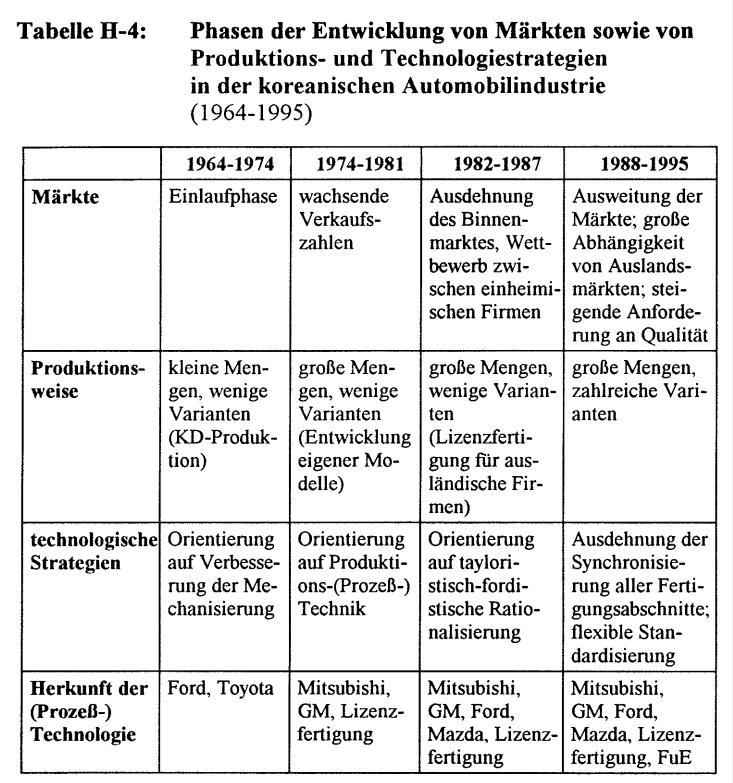
Table H-4 “Phases of the development of markets as well as production and technology strategies in the Korean automotive industry (1964-1995)”
Herkunft der (Prozeß-) Technologie, translation: Origin of the Process-Technology is the part that we translated because that is what we are interested in highlighting from the “Phases of the development of markets as well as production and technology strategies in the Korean automotive industry (1964-1995)” table. Another is this, as shown below in a diagram about the pyramidal organization of auto parts suppliers (“small” and “medium” companies), which are dominated by the auto assemblers (“car producers”):
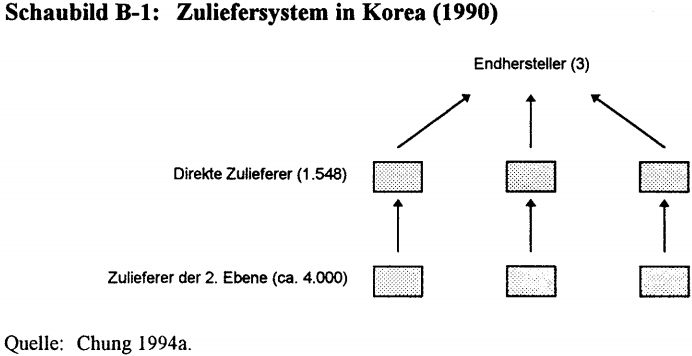
Schaubild B-1: Zukliefersystem in Korea (1990): Table B-1: System of supplier companies in Korea (1990)
Endherasteller: Final manufacturer or automobile assembly company
Direkte Zulieferer: Direct supplier
Zulieferer der 2. Ebene (ca…): 2nd level provider (circa..)
Quelle: Chung 1994a: Source: Chung1994 a
So now we say: at the head of this system of suppliers to the automobile industry in Korea, there are three bureaucratic capital companies, which receive the auto parts and components (under license from the big imperialist automobile monopolies) from the 1,548 direct suppliers; which in turn, have been supplied by 4,000 second-level suppliers. Meaning: 3 assembly companies – which are dependent by their very nature upon the big imperialist monopolies, because of the “holding system” – dominate 5,548 “medium” and “small companies”.
In summary: the so-called “industrialization of South Korea” is nothing other than the development of bureaucratic capitalism in that society, driven principally by Yankee imperialism and Japanese imperialism and other imperialist countries, in collusion and struggle. And, as we have seen, by their own confession, the result is the dependence of Korea’s economy on the world market, meaning, upon the interests and needs of imperialism, a dependency that according to Lenin, is nothing other than a relationship of “oppression and violence” of the imperialist economy over the Korean economy. With this comes the bureaucratic character of capitalism in this country.
THE CASE OF TAIWAN: FDI and so-called “technology transfer”
Among the many fairytales told by the publicists of imperialism and the opportunists of all countries, one such tale goes: that today the “dependence” of the backward countries has lessened, because now “the foreign capital we need” comes as foreign direct investment (FDI), “indispensable for technology transfer” and therefore for “independent development”, because “foreign capital” now no longer comes primarily as “ensnaring” loans. or public debt – and in the meantime the so-called “development aid” is overlooked – another way in which the imperialists intervene in the economic policy of our countries for the benefit of their export of capital and goods and to broaden the social base in their favor in the recipient country, even more so the Japanese “aid” is omitted. Furthermore, they add that much of this FDI now comes from Third World countries like our own, thus it supposedly has a different character. This makes it necessary to address this issue by raising some fundamental questions based on specific situations.
Therefore, it is appropriate to introduce, with our comments, some excerpts from the Case Study of Taiwanese-Japanese Joint Ventures in China: Case Study of Taiwanese-Japanese Joint Ventures in China. Behavior and setting goals in company interviews. The transfer of a package of FDI.., Chapters 1, 3-4 pdf, by JM Gerken, 2000 (15) which clearly demonstrates the class character of this FDI that comes in a “package”, supported by first-hand information and extensive specialist literature.
What is the importance of this work, and what are its limitations? Its importance is rooted in the fact that it is a case study; it links the macro and microeconomic aspects of Japanese FDI in Taiwan, which takes the form of a “FDI package transfer” or “transfer of the production of simple standardized products” which will then “be made clear in the next investment in the series of the cycle (Catching-up Product Cycle)”, i.e, in the next Japanese-Taiwanese investment in China.
As can be inferred, on our part, we intend to use this empirical information to show how imperialist financial capital (Japanese, in this case) contributes to generating the intermediary company (subsidiary or daughter) of Taiwanese bureaucratic capitalism and how Japanese imperialist capital, through these investments, will then penetrate China. We intend to use these concrete cases to demonstrate how these “international networks” of dependence and of financial capital relations are generated, and how it, after generating the monopolies and their networks in the countries of origin (imperialist), extends into the countries of the Third World and to China as the most economically backward imperialist country and where investments are more profitable, and obtains superprofits.
The problem or limitation, is how the author sees the “cycle” of imperialist finance capital; he sees it limited solely to the first moment of the cycle and does not see the complete cycle of the Japanese FDI; he sees the second part of the cycle as a new investment of the recipient country or, at the very least, a “hybrid”: Japanese direct investment in Korea (subsidiary or daughter company of the main Japanese company or mother company), then Japanese-“Korean” investment in China (granddaughter company) or in other countries such as Vietnam or the Philippines (granddaughter companies). We must apply the method established by Lenin in order to determine the nature of these investments, that is to say the method of the “holding system”.
The author, though contradictory with his exposition of the facts, following his mentor Koljima takes the second moment of the imperialist FDI as direct investments of the NIEs (New Industrial Economies) in the ASEAN region and then in China and Vietnam. He calls them “new direct investments” and “extension of the product cycle”: the Catching-up Economies. In other words, the study focuses on the simple, standardized, Japanese product which is transferred in the FDI to be produced in Taiwan (applied to the conditions of the country: “new standardized product”), which is then extended or transferred to be produced in China.
As expected, the study focuses on the relations between things (commodity fetishism) and not upon the relations which these “things” hide; that is to say, it does not focus on the social relations of production. This is the main thing that for the moment we must stress regarding the quotes that follow. Why? Because in addition to their bourgeois conception, as Lenin pointed out in his aforementioned work, these academics see subsidiary companies as independent because they are thus legally, and because they seek to embellish imperialism. But, as Lenin himself told us, we are dealing with “a
[work of]
literature.. written from the bourgeois point of view, but which, nevertheless, gives a fairly truthful picture and criticism—petty-bourgeois, naturally—of this financial oligarchy” (op. Cit.)
Let’s take a look at the quotes:
“The macroeconomic theory of foreign direct investment (FDI) developed by Kojima gives this issue an adequate framework, since this later helps to link it up with the microeconomic aspect. Kojima analyses the effect of the FDI on the recipient country and notes that Japan’s FDI differs from American and European FDI. In an effort to clarify this detail, Kojima identifies the existence of a type of FDI, which Catching-up Economies prefer to implement and then continue throughout East Asia. In this relationship one can speak of the direct investment cycle, which, firstly begins from an industrial country and passes to an emerging country and then on to a developing country. From the 1970s, it was observed that the Newly Industrialized Economies (NIEs) in South Korea, Taiwan, Singapore and Hong Kong carried out direct investments in the ASEAN states, whereas they were still mostly recipients of FDI in the 1950s and 1960s. In the second half of the 1980s, the NIEs began to invest in China and Vietnam. With the beginning of the new direct investment cycle, the entrepreneurs of the NIEs showed that they had acquired technical knowledge, capital and business management knowledge and that the extension of the product cycle had also taken place at that level. In the empirical part, we will examine the role Japanese FDI has played in the development of Taiwanese direct investments in China, and what particular knowledge of the product, process and business management knowledge of Japanese subsidiaries in Taiwan has been employed in the subsequent investment in China. In this example, the advances in the knowledge of the Taiwanese partner can be observed at the micro level. Some of these Taiwanese investors apply in China the products and technological processes that they have developed or adapted to local conditions. In this case there is talk of a “hybrid technology transfer”, which under certain circumstances is more appropriate to Chinese conditions” (op. cit. Introduction).
So, reference has been made to the product “cycle” through the “phenomenon of subsequent investment” (macroeconomic level), centred on the microeconomic (business) aspect, meaning – what precisely the “contribution of the subsidiary company” is in “the reproduction of a given good”. This is how they take up “the direct investment instrument” (Introduction). “The business equipment variable denotes the transfer of the FDI package, which consists of product knowledge, process knowledge, and business management knowledge. Capital can be supplemented or substituted through specific industrial patrimony, tangible or intangible, such as second-hand production machines”.
Continuing with the quotes from the study: “Similarly to Japan, in Taiwan comparative advantages in labour-intensive industries have declined (labour-intensive use is typical of backward economies, our note). As such, Taiwan itself began to transfer its labour-intensive industries to low-wage countries (as can be seen, a whole hierarchy is established by the degree of development, measured by the use of labour among the companies of the different countries that belong to the “holding system”, of a determined parent monopoly, our note). As industrialization progressed, international export experience spurred Taiwan’s investments in Southeast Asia. Taiwanese subsidiaries were strengthened by local comparative advantages. Taiwanese investments in the mainland (in the People’s Republic of China, our note) grew by about US$ 30 billion from 1983-1996.
The comparison of Japanese FDI in Taiwan with Taiwanese direct investments in China in the electrical and electronics industry expresses Japan’s strong involvement. Between 1952 and 1997, more than a quarter (27%) of Japanese investment capital flowed into this branch. 375 small and medium-sized entrepreneurs as well as 33 large Japanese entrepreneurs founded one or more subsidiaries in Taiwan. The product range of the Japanese companies encompasses everything from cables to computers. These products include many standardized parts, components, and simple additives. Taiwanese investments in monitors, keyboards and other peripheral devices are noteworthy. These are almost all past models that were transferred to China, e.g. 15-inch displays. Japanese presence is even more evident in the Taiwanese automobile industry. Eight of the eleven self-assembly producers have a joint venture and/or a contract of cooperation with the Japanese. In Taiwan, the same model was reassembled just as in Japan. This also expresses a closed merger with the Taiwanese auto producer. Here you will also find examples for simple parts, bodies, transmissions, which were transferred to China as part of the subsequent investment.
In Southeast Asia, the foreign direct investments of the NIEs are predominantly small and medium sized entrepreneurs, who have so far extended their production of simple goods overseas or moved there completely. One of the cornerstones of this are the favourable trade conditions which are being discussed between the European Union or NAFTA and the ASEAN states. Another cornerstone for direct investments by NIEs: the local markets in Southeast Asia (economies of scale, note from us), which have previously taken imports from NIEs. Among the most recent waves of NIEs investors are mobile exporters, who preferentially move their production because of low wages. In Southeast Asia, simple electronic parts and electronic devices, optical components (for example, lenses) and furniture parts are assembled.
The reason for low labour costs and market orientation is once again illustrated by the three predominant strategies of Taiwanese investments in China, mature products with labour-intensive production methods affect the “three C’s”: Consumer Electronics, Computer and Communication. It is a breakdown of complex technical processes of high-tech products and standardized primary and intermediate products which takes place within the international division of labour. Within the scope of these standardized products (primary and intermediate) particularly small and flexible companies from newly industrialized economies (NIEs) enter as joint venture partners or OEM producers (Original Equipment Manufacturer, our note). A typical pattern of this international division of labor is to be found in the PC industry. At the forefront are U.S. companies, which develop software systems for PCs and make central processing units (CPUs). Japanese companies provide some key components (e.g. liquid crystal displays: LCD)”.
A comment from us, even though it is a company from another country: This is very important because it shows the intermediary character of the Korean monopoly company SAMSUNG that employs these softwares; because it makes it clear that it is U.S. imperialist finance capital that dominates the region, followed by Japanese imperialist capital and then by the other imperialists.
The intermediary role or function of the companies of the countries of bureaucratic capitalism or of Chinese imperialism subject to the needs of the US, Japanese, etc imperialist financial capital is behind them, as we read below:
“For some computer parts there are specialized suppliers in South Korea and Singapore. Taiwanese manufacturers aim to provide higher quality peripherals and individual components. The provision of simple devices, e.g. keyboards, intermediate products, parts, is taken over by companies in China and the ASEAN states (…) The outsourcing of the production of labour-intensive products and simple precursor products progresses and has to do with the production of said parts and components which Taiwan has specialized in. For LCD production, for example, the lowest production level of an LCD screen is produced by a Taiwanese company in China. The rapid implementation of product improvements (e.g. 17 inch displays) leads the lower levels (such as 14 and 15 inch displays) to a standardized method of production so that these “obsolete products” can remain on the market” (previously cited work).
As a result, the export of imperialist capital means that its economic crisis is also exported to overseas countries and an entire international network of dependencies and connections of financial capital is established, as Lenin warned us: “Paramount importance attaches to the “holding system (…) The German economist, Heymann, probably the first to call attention to this matter, describes the essence of it in this way: “The head of the concern controls the principal company [literally: the “mother company”]; the latter reigns over the subsidiary companies [“daughter companies”] which in their turn control still other subsidiaries [“grandchild companies”], etc. In this way, it is possible with a comparatively small capital to dominate immense spheres of production. Indeed, if holding 50 per cent of the capital is always sufficient to control a company, the head of the concern needs only one million to control eight million in the second subsidiaries. And if this ‘interlocking’ is extended, it is possible with one million to control sixteen million, thirty-two million, etc.” (…) To divide a single business into several parts by setting up ‘daughter companies’—or by annexing them. The advantages of this system for various purposes—legal and illegal—are so evident that big companies which do not employ it are quite the exception. (…) the “democratisation of capital”, the strengthening of the role and significance of small-scale production, etc., is, in fact, one of the ways of increasing the power of the financial oligarchy. (…) But the “holding system” not only serves enormously to increase the power of the monopolists; it also enables them to resort with impunity to all sorts of shady and dirty tricks to cheat the public, because formally the directors of the “mother company” are not legally responsible for the “daughter company”, which is supposed to be “independent”, and through the medium of which they can “pull off” anything. (…) A monopoly, once it is formed and controls thousands of millions, inevitably penetrates into every sphere of public life, regardless of the form of government and all other “details”.
(…) The supremacy of finance capital over all other forms of capital means the predominance of the rentier and of the financial oligarchy; it means that a small number of financially “powerful” states stand out among all the rest. (…) In one way or another, nearly the whole of the rest of the world is more or less the debtor to and tributary of these international banker countries, these four “pillars” of world finance capital. It is particularly important to examine the part which the export of capital plays in creating the international network of dependence on and connections of finance capital.”16
The exposition of the facts concerning the development of imperialism and consequently bureaucratic capitalism in Southeast Asia over the last three decades and beyond demonstrates the full validity of what has been established by Marxism-Leninism-Maoism regarding imperialism and bureaucratic capitalism.
What we have seen is an increased export of capitals and consequently the heightened struggle between the big monopolies and [imperialist] countries, to penetrate the economies of these countries more thoroughly and extensively; whose production is becoming more and more dependent on these capitals and more deformed, as they produce for the needs of the imperialist world market rather than for internal development. Thus, we have seen the development of the “international network of dependency and the connections of finance capital”, in other words “global value production networks” of the biggest imperialist monopolies or MNEs, “international production networks”, or whatever the economists of imperialism wish to call them. These networks are nothing more than the tentacles of the biggest monopolies for contesting the economic territory of the world through peaceful or violent means, which the author of the “Case Study..” sees as the cycle of FDI and of the “product” or which others refer to as the “global value production chains”. For our countries, this has meant a further deepening of their semi-colonial semi-feudal condition upon which bureaucratic capitalism develops.
Regarding this subject, Lenin said: Typical of the old capitalism, when free competition held undivided sway, was the export of goods. Typical of the latest stage of capitalism, when monopolies rule, is the export of capital. (….) Capitalism is commodity production at its highest stage of development, when labour-power itself becomes a commodity. The growth of internal exchange, and, particularly of international exchange, is a characteristic feature of capitalism. The uneven and spasmodic development of individual enterprises, individual branches of industry and individual countries is inevitable under the capitalist system. (….) An enormous “surplus of capital” has arisen in the advanced countries.
It goes without saying that if capitalism could develop agriculture, (…) if it could raise the living standards of the masses, (…) there could be no question of a surplusof capital. (…) both uneven development and a semi-starvation level of existence of the masses are fundamental and inevitable conditions and constitute premises of this mode of production. As long as capitalism remains what it is, surplus capital will be utilised not for the purpose of raising the standard of living of the masses in a given country, for this would mean a decline in profits for the capitalists, but for the purpose of increasing profits by exporting capital abroad to the backward countries. In these backward countries profits are usually high, for capital is scarce, the price of land is relatively low, wages are low, raw materials are cheap. The export of capital is made possible by a number of backward countries having already been drawn into world capitalist intercourse; (…) elementary conditions for industrial development have been created, etc. The need to export capital arises from the fact that in a few countries capitalism has become “overripe” and (owing to the backward state of agriculture and the poverty of the masses) capital cannot find a field for “profitable” investment.
Thus finance capital, literally, one might say, spreads its net over all countries of the world. An important role in this is played by banks..
The capital-exporting countries have divided the world among themselves in the figurative sense of the term. But finance capital has led to the actual division of the world.
Since we are speaking of colonial policy in the epoch of capitalist imperialism, it must be observed that finance capital and its foreign policy, which is the struggle of the great powers for the economic and political division of the world, give rise to a number of transitional forms of state dependence. Not only are the two main groups of countries, those owning colonies, and the colonies themselves, but also the diverse forms of dependent countries which, politically, are formally independent, but in fact, are enmeshed in the net of financial and diplomatic dependence, typical of this epoch. We have already referred to one form of dependence—the semi-colony. An example of another is provided by Argentina.
“South America, and especially Argentina,” writes Schulze-Gaevernitz in his work on British imperialism, “is so dependent financially on London that it ought to be described as almost a British commercial colony.”17
TECHNOLOGY TRANSFER AND THE FDI PACKAGE
Let us continue with the “Case study”:
“The transfer of the FDI package includes products and processes and management of specific technologies, the components of which are regulated according to a contract. Thus, the transfer options are, from the very outset of each foreign direct investment project, limited by these agreements. The degree of success that is possible for the native party to achieve is crucial, starting from the package of FDI at its disposal, combined with their own abilities to establish production. In many cases, the transfer of real knowledge consists of the investor’s own knowledge (know-how), which cannot be transmitted completely in the technical specifications drawings and operating instructions, etc., which can be agreed upon. It is therefore important to ascertain what knowledge is actually and truly transferred by the foreign investor. Often, the quality of the production is consciously reduced to a minimum, so as not to jeopardize the technical advantage of the foreign investor, or simply to prevent the foreign branch from producing exactly the same component. In some cases the recipient has found that although all the technical information is accurate, the foreign branch can produce exactly the same component. In some cases the recipient has experienced that although all the technical information is complete, there is still something missing. This lack of knowledge lies in the experience of the investor, and there is no rule of thumb for predicting when and to what extent, the recipient of this knowledge can acquire said experience. For example, the drawings contain precise technical data and precise manufacturing instructions. However, some of the information is missing, e.g. the optimum manufacturing temperature, which is only discovered after several years. It is therefore impossible to determine the exact value of the investor’s intangible assets, but it is up to the receiving party to determine the specific value of this knowledge in greater depth.”
In addition, we would like to note that what is transferred in each “investment project” is a “product” etc, or a model already in production, so no matter whether it is “the newest” or the latest, it is already obsolete, because the parent company is already researching and developing a new one, and this research and development (R&D) is not transmitted within the package, it remains with the parent company. Moreover, machines for manufacturing workshops are older models and in many cases have been withdrawn, i.e. they have zero or symbolic value in the books and when they are exported as part of the FDI “package” they acquire a new value as a fixed asset in the foreign accounts of the subsidiary. But even if these machines are of the “latest generation”, these machines do not in any way contribute to the technological development of the host country since they are foreign products, and, by the same token, do not signify the development of the machine production sector to produce machines for industry in the host country. But, the main thing to emphasize is that foreign investment is carried out according to the development interests of the monopoly in the struggle for the world market, etc., and the enterprises generated in the oppressed countries or in the most backward imperialist countries like China, remain subject to a thick network or are bound by tentacles to the imperialist enterprises, which ensure by all means and in all cases the subjugation of the enterprises which imperialist finance capital played an instrumental role in generating.
Taiwan: Another of the “four Asian tigers”
Of the so-called “four Asian tigers”, Taiwan is another. It is dominated by imperialism, principally Yankee, in collusion and struggle with Japanese imperialism and other imperialist countries. The study of Taiwan demonstrates how the process of the greater domination of imperialism in recent decades has been carried out, just like it has in the other oppressed countries; which they try to hide with their terminology of “globalisation”, “new international division of labour”, “integration into the global production chain”. That is why it is good to take some concrete data into account, such as those contained in the above-mentioned research concerning the period 1952-1997, which we include as a note.18
After what we include as a note, the article says: “On the other hand, Taiwan is also an active overseas investor with the objective of expanding ts network of production & distribution and of penetrating into new markets. In this sense, the financial and insurance sector dominated in 2012, and its outflow abroad tripled to more than US$4.5 billion. In second place came, as expected, the electronics sector with US$1.35 billion, metallurgical equipment with US$643.4 million came in third place. Of the US$8.1 billion of direct investments with which Taiwan undertook foreign ventures, the largest share went to Singapore in 2012, US$4.5 billion or 55.6% flowed into the city State of Southeast Asia. The share of capital invested in Japan was 13%, in Vietnam, 11.7%. Finally 0.2% of Taiwanese investments went to Germany (Information from the Taiwanese Ministry of Economic Affairs Investment Commission, 2013). In any case, investments originating in Taiwan and operating respectively in mainland China are not listed here. In reality, the investments by Taiwanese companies in the PR China represent the largest share of investments, despite the fact that the Taiwan Investment Commission in 2012 recorded only an investment of US$ 10.9 billion, which went to the other side of the Taiwan Strait, 17% less than in the previous year. Of this, US$1.95bn went to the electronics sector and US$1.52bn to the information and communications technology sector.
At the same time, mainland China’s investments in Taiwan from 2011 to 2012 grew more than sevenfold to reach US$328 million. This is a decisive expansion of the scope, within such investments, that is authorized. It was only in August 2012 that Taiwan and China PR signed an agreement to protect and promote investment.”19
The underlining in the preceding quotation is ours. With it, we want to emphasize the intermediary role of the monopolies of bureaucratic capitalist countries like Taiwan, as we saw previously and we will see more clearly in: on “the motives of Japanese investments in Taiwan” (daughter companies), in comparison with the motives of these investments in China (granddaughter companies). Likewise, by comparing the investments of the grand comprador bourgeoisie of Taiwan in Southeast Asia with what we saw earlier with regard to the development of FDI and the parts industry for the electronics and high-tech industry (HT), this allows us to understand the importance Lenin gives to the “holding system” in order to understand imperialism as the stage of the domination of the monopolies generated by finance capital, in contrast to the stage of free competition capitalism. The monopolies of the countries of bureaucratic capitalism have been generated and are subject, subordinated by the most varied ties, to the monopolies of the imperialist countries. Ultimately, their existence depends on them.
One point which we can already establish is that the increase in foreign investment by the imperialist countries is followed by the apparent decrease in their exports to the semi-colonial countries or to other imperialist countries, especially those which are less developed, such as China (law of unequal development); This is particularly evident in the case of U.S. imperialism and Japanese imperialism with regard to this region of Asia (an expression of imperialist parasitism and of economic backwardness in the imperialist countries caused by the export of capital).
Another point is that a great part of imperialist investment in China is done through Hong Kong, Taiwan and South Korea, which act as platforms for imperialist finance capital. This becomes even more obvious when we consider how imperialist investment is growing in these countries, in the development of the banks and their financial sector, just as the Chinese imperialists are seeking to reorganize and further develop their banking and financial sector and services sector in general.
Taiwan is now being surpassed by Korea as the second largest investor in China. For this reason, in regional scenarios we cannot overlook the subordinate and subjugated role it represents with respect to the interests of its owner, which the struggles between the grand intermediary bourgeoisie of the semicolonial countries represent. That is why we include the following footnote concerning Taiwanese investments in China.20
To concretely see “the holding system” the result of the study is of use, which we include as a note on: “3. Business structure of Japanese subsidiaries in Taiwan” and items 4, 6, and 5 of the case study”.21
THE UNDERSTANDING OF MARXISM-LENINISM-MAOISM OF THIS PROCESS IN ITS ENTIRETY
Let us ask ourselves: How do we understand this process? What is the nature of this development? It has been established that this whole process in the oppressed countries is under the domination of imperialist foreign investment.
In 1975, Chairman Gonzalo asked himself a similar question about the national situation, and he responded thusly:
“How does Marxism see the question? Mao Zedong analyses this problem in “On Coalition Government”, as can be read on page 302 in Volume III of his works: “In order to defeat the Japanese aggressors and build a new China it is necessary to develop industry. But under the Kuomintang government there is dependence on foreign countries for everything, and its financial and economic policy is ruining the entire economic life of the people. A few small industrial enterprises are all that is to be found in the Kuomintang areas, and in most cases they have been unable to avoid bankruptcy. In the absence of political reforms all the productive forces are being ruined, and this is true both of agriculture and of industry.
By and large, it will be impossible to develop industry unless China is independent, free, democratic and united. To wipe out the Japanese aggressors is to seek independence. To abolish the Kuomintang’s one-party dictatorship, establish a democratic and united coalition government, transform all China’s troops into a people’s armed force, carry out land reform and emancipate the peasants is to seek freedom, democracy and unity. Without independence, freedom, democracy and unity it is impossible to build industry on a really large scale. Without industry there can be no solid national defence, no well-being for the people, no prosperity or strength for the nation.”
In Mariátegui’s opinion regarding this matter (…) we highlight: “Imperialism does not allow any of these semicolonial peoples, whom it exploits as a market for capital and commodities and as a source for raw materials, to have an economic program of nationalization and industrialization; it compels them to undertake monopolization and monoculture (petroleum, copper, sugar, cotton in Peru)…”
So, for Mariategui, imperialism does not allow us to develop truly national industry; at the service of the nation, nor an independent industrialization program; and if the possibilities of industry are indeed limited by the “structure and character of the national economy”, “it is further limited by the dependence of economic life on the interests of foreign capitalism” as it teaches us in “Capitalism or Socialism”.
This is the situation in our country: Industry is developing as dependent industry, and, in consequence, submitted to the interests of imperialism, principally North American (…) Since before the Second World War, there have been multiple opportunities to stimulate the industrial process whilst at the same time developing the direct participation of the State in said process. But, as it could not be any other way, given the classes that command the State, the vision that motivates them is to develop a process of industrialization under the canopy of imperialism”.
That’s exactly it! It’s as if this was written as a commentary upon the studies quoted further above regarding economic development in Asia.
President Gonzalo continues further down in the article of “People’s Voice”: “(…) How should one understand bureaucratic capitalism in our country? (…) Mao Zedong extraordinarily – although in a condensed form – in his Selected Works, presents us with the question of bureaucratic capitalism; in Volume III, in “On Coalition Government”, while considering the serious situation which the great popular masses found themselves in under the domination of the Kuomintang, he says:
“Why has such a grave situation arisen under the leadership of the Kuomintang’s chief ruling clique? It has arisen because that clique represents the interests of China’s big landlords, big bankers and the magnates of the comprador bourgeoisie. The handful of people forming this reactionary stratum monopolize all the important military, political, economic and cultural organizations under the Kuomintang government.* They.. too say “the nation above all”, but their actions do not accord with the demands of the great majority of the nation. They too say “the state above all”, but what they mean is the feudal-fascist dictatorship of the big landlords, big bankers and big compradors, and not a democratic state of the people. Therefore they are afraid of the rise of the people, afraid of the democratic movement… They talk about developing China’s economy, but in fact they build up their own bureaucrat-capital, i.e., the capital of the big landlords, bankers and compradors, and monopolize the lifelines of China’s economy, ruthlessly oppressing the peasants, the workers, the petty bourgeoisie and the non-monopoly bourgeoisie. They talk about putting “democracy” into practice and “handing state power back to the people”, yet they ruthlessly suppress the people’s movement for democracy and refuse to introduce the mildest democratic reform. (Pg. 224. Emphasis placed by, like in all other quotes, “People’s Voice”)”
Let us take note of the key issue, Mao (meaning Chairman Mao, our note) defines bureaucratic capital as being that of the big landowners, big bankers and magnates of the comprador bourgeoisie, firstly; secondly he points out that bureaucratic capital monopolizes the economy; and, thirdly, “ruthlessly
[oppresses]
the peasants, the workers, the petty bourgeoisie and the non-monopoly bourgeoisie.” From this basis and economic position, the reactionary political character of bureaucratic capital necessarily derives. In Volume IV Mao analyzes the process of development of bureaucratic capitalism:
“Confiscate the land of the feudal class and turn it over to the peasants. Confiscate monopoly capital, headed by Chiang Kai-shek, T. V. Soong, H. H. Kung and Chen Li-fu, and turn it over to the new-democratic state. Protect the industry and commerce of the national bourgeoisie. These are the three major economic policies of the new-democratic revolution. During their twenty-year rule, the four big families, Chiang, Soong, Kung and Chen, have piled up enormous fortunes valued at ten to twenty thousand million U.S. dollars and monopolized the economic lifelines of the whole country.This monopoly capital, combined with state power, has become state-monopoly capitalism. This monopoly capitalism, closely tied up with foreign imperialism, the domestic landlord class and the old-type rich peasants, has become comprador, feudal, state-monopoly capitalism.Such is the economic base of Chiang Kai-shek’s reactionary regime. This state-monopoly capitalism oppresses not only the workers and peasants but also the urban petty bourgeoisie, and it injures the middle bourgeoisie. This state-monopoly capitalism reached the peak of its development during the War of Resistance and after the Japanese surrender; it has prepared ample material conditions for the new-democratic revolution. This capital is popularly known in China as bureaucrat-capital. This capitalist class, known as the bureaucrat-capitalist class, is the big bourgeoisie of China. (Cited work, Pg. 167, “Present Situation and Our Tasks”)”.
Let us pass immediately to the comment Chairman Gonzalo made on the quote in the previously cited “People’s Voice” article:
“In this text Mao establishes the development of bureaucratic capitalism, he shows us how this capital of the four families piled up enormous fortunes, completely monopolizing the economy. He then points out how monopoly bureaucratic capital “combined with state power, has become state-monopoly capitalism”; this is significant – monopoly capital by interlinking with the state, becomes state monopoly capital – not simply, as some believe, state capitalism. The most important thing is that it is monopoly [capital] and this is the essence of its unbreakable bond with imperialism (remember that Lenin demonstrated that the economic essence of imperialism is its condition as monopoly capitalism). On the other hand, Mao teaches us: that this monopoly capitalism which is “closely tied” to imperialism, to the landlords and to the rich peasants of old type in its development “has become”, as he puts it, “state monopoly capitalism, comprador and feudal”. Mao Zedong feels, not only that this is the economic base of the Kuomintang regime; but also that this state-monopoly capitalism oppresses the workers and peasants and “also the urban petty bourgeoisie, and injures the middle bourgeoisie”. And, finally, in reaching “the peak of its development… it has prepared ample material conditions for the new-democratic revolution”; this is a point of extraordinary importance; even though among us there is talk of bureaucratic capitalism, no attention is paid to the fact that this, in its development, matures the conditions for the national democratic revolution.
We must study this grand thesis of Mao Tsetung concerning bureaucratic capitalism very seriously and use it as a guideline to judge our process of capitalist development”.
Here, Chairman Gonzalo posits the necessity for us to understand bureaucratic capitalism, and this is applicable not only to our own society; but also to understand social formations which are similar to ours, which is essential to carrying out democratic revolution.
Chairman Gonzalo: “Taking up Chairman Mao’s thesis, teaches us that it has five characteristics: 1) that bureaucratic capitalism is the capitalism that imperialism develops in the backward countries, which is comprised of the capital of large landowners, the big bankers, and the magnates of the big bourgeoisie; 2) it exploits the proletariat, the peasantry, and the petty bourgeoisie and constrains the middle bourgeoisie; 3) it is passing through a process in which bureaucratic capitalism is combined with the power of the State and becomes State monopoly capitalism, comprador and feudal, from which can be derived that in a first moment it unfolds as a non-State big monopoly capitalism and in a second moment, when it is combined with the power of the State, it unfolds as state monopoly capitalism; 4) it ripens the conditions for the democratic revolution as it reaches the apex of its development; and, 5) confiscating bureaucratic capital is key to reaching the pinnacle of the democratic revolution and is decisive in passing over to the socialist revolution.
In applying the above, he conceives that bureaucratic capitalism is the capitalism that imperialism generates in the backward countries, which is tied to a decrepit feudalism and subjugated to imperialism which is the last phase of capitalism. This system does not serve the majority of the people but only the imperialists, the big bourgeoisie, and the landowners. (…) it is, thus, a bureaucratic capitalism that oppresses and exploits the proletariat, the peasantry, and the petty bourgeoisie, and that constricts the middle bourgeoisie. Why? Because the capitalism that develops is a delayed process that only allows an economy to serve imperialist interests. It is a capitalism that represents the big bourgeoisie, the landowners and the rich peasants of the old type, the classes that constitute a minority but which exploit and oppress the large majority, the masses.
He analyzes the process that bureaucratic capitalism has followed in Peru, the first historical moment which develops from 1895 to the Second World War, in which, during the 1920s, the comprador bourgeoisie assumes control of the State, displacing the landlords but respecting their interests. The second moment is from the Second World War to 1980, a period of its deepening, during which a branch of the big bourgeoisie evolves into the bureaucratic bourgeoisie (…) Thus a clash between both factions of the big bourgeoisie is generated, between the bureaucratic and the comprador bourgeoisie. (…) The third moment is from 1980 onward, in which bureaucratic capitalism enters into a general crisis and its final destruction (…) and no measure can save it. At best it shall lengthen its agony. On the other hand, like a beast in mortal agony, it will defend itself by seeking to crush the revolution.
If we see this process from the people’s road, in the first moment the PCP was constituted with Mariátegui in 1928, and the history of the country was divided into two; in the second, the PCP was reconstituted as a Party of a new type with Chairman Gonzalo and revisionism was purged; and in the third, the PCP entered to lead the People’s War, a transcendental milestone which radically changed history by taking the qualitatively superior leap of making the conquest of power a reality by way of armed force and the People’s War. All of this only proves the political aspect of bureaucratic capitalism that is rarely emphasized, but which Chairman Gonzalo considers as the key question: Bureaucratic capitalism ripens the conditions for revolution, and today as it enters into its final phase, it ripens the conditions for the development and victory of the revolution.
It is also very important to see how bureaucratic capitalism is shaped by non-State monopoly capitalism and by State monopoly capitalism, that is the reason why he differentiates between the two factions of the big bourgeoisie, the bureaucratic and the comprador, in order to avoid tailing behind one or the other, a problem that led our Party to 30 years of wrong tactics. It is important to understand it this way, since the confiscation of bureaucratic capitalism by the New Power leads to the completion of the democratic revolution and the advance into the socialist revolution. If only the State monopoly capitalism is targeted, the other part would remain free, the non-State monopoly capital, and the big comprador bourgeoisie would remain economically able to lift its head to snatch away the leadership of the revolution and to prevent its passage to the socialist revolution.
Furthermore, Chairman Gonzalo generalizes that bureaucratic capitalism is not a process peculiar to China or to Peru, but that it follows the belated conditions in which the various imperialists subjugate the oppressed nations of Asia, Africa, and Latin America, at a time when these oppressed nations have not yet destroyed the vestiges of feudalism, much less developed capitalism.
In synthesis, the key question to understand the process of contemporary Peruvian society and the character of the revolution is this Marxist-Leninist-Maoist, Gonzalo Thought thesis on bureaucratic capitalism, which is a contribution to the world revolution that we, upholders of Marxism-Leninism-Maoism and Gonzalo Thought, have firmly taken up”.
We have quoted this part of the PCP document “Line of the Democratic Revolution” from the First Congress in full because of the key importance this topic holds for the Communists of the world, and with regards to this there is another question of paramount importance to carrying out the democratic revolution and digging up the three mountains that oppress us, so we must continue with the quote from Chairman Mao which is discussed in the same “People’s Voice” article, which says:
“Besides doing away with the special privileges of imperialism in China, the task of the new-democratic revolution at home is to abolish exploitation and oppression by the landlord class and by the bureaucrat-capitalist class (the big bourgeoisie), change the comprador, feudal relations of production and unfetter the productive forces. The upper petty bourgeoisie and middle bourgeoisie, oppressed and injured by the landlords and big bourgeoisie and their state power, may take part in the new-democratic revolution or stay neutral, though they are themselves bourgeois. They have no ties, or comparatively few, with imperialism and are the genuine national bourgeoisie. Wherever the state power of New Democracy extends, it must firmly and unhesitatingly protect them. In Chiang Kai-shek’s areas, there are a small number of people among the upper petty bourgeoisie and the middle bourgeoisie, the right wing of these classes, who have reactionary political tendencies, spread illusions about U.S. imperialism and the reactionary Chiang Kai-shek clique and oppose the people’s democratic revolution. As long as their reactionary tendencies can affect the masses, we should unmask them before the people under their political influence, attack this influence and liberate the masses from it. But political attack and economic annihilation are two different matters, and we shall make mistakes if we confuse the two. The new-democratic revolution aims at wiping out only feudalism and monopoly capitalism, only the landlord class and the bureaucrat-capitalist class (the big bourgeoisie), and not at wiping out capitalism in general, the upper petty bourgeoisie or the middle bourgeoisie. (Chairman Mao, Selected Works, Vol. IV, PRESENT SITUATION AND OUR TASKS, p167-168)”.
Apropos, Chairman Gonzalo reminds us that the task of applying Marxism to the study of the development of capitalism in agriculture fell to Lenin, and that the peasant path has been extraordinarily studied and developed by Chairman Mao. And he tells us: “In turning to [Lenin], we find a solid basis, from the conception of the working class, upon which to judge such a substantive question. In “The Agrarian Programme of Social-Democracy in the Russian Revolution”, in Volume 15 of his Collected Works, Lenin teaches us that:
“..this development in a capitalist country may take place in two different ways. Either the latifundia remain, and gradually become the basis of capitalist economy on the land. This is the Prussian type of agrarian capitalism, in which the Junker is master of the situation. For whole decades there continue both his political domination and the oppression, degradation, poverty and illiteracy of the peas ant. The productive forces develop very slowly…”
“Or else the revolution sweeps away the landed estates. The basis of capitalist agriculture now becomes the free farmer on free land, i. e., land clear of all medieval junk. This is the American type of agrarian capitalism, and the most rapid development of productive forces under conditions which are more favourable for the mass of the people than any others under capitalism.”
“In reality the struggle going on in the Russian revolution is not about “socialisation” and other absurdities of the Narodniks—this is merely petty-bourgeois’ ideology, petty- bourgeois phrase-mongering and nothing more—but about what road capitalist development of Russia will take: the “Prussian” or the “American”. Without ascertaining this economic basis of the revolution, it is absolutely impossible to understand anything about an agrarian programme”.
“…All the Cadets (party of the grand bourgeoisie) do their utmost to obscure the essence of the agrarian revolution… The Cadets mix up (“reconcile”) the two main types of agrarian programme in the revolution—the landlord and the peasant types. Then (also in a few words): in Russia both types of capitalist agrarian evolution already made their appearance in the years between 1861 and 1905—both the Prussian (the gradual development of landlord economy in the direction of capitalism) and the American (differentiation of the peasantry and a rapid development of productive forces…)” (Cursive is from the original. Underlined emphasis is ours, same as in the previous quotes. That is to say in the original “People’s Voice”).
Here, the two paths in the countryside are masterfully laid out, the countryside which is the “economic base of the revolution” from which we must start and whose circumvention is absolutely unacceptable. But this is not all, Lenin establishes a relationship between these two economic paths and political paths. In the same work, he says:
“The genuine historical question which objective historical and social development is putting to us is: a Prussian or an American type of agrarian evolution? A landlords’ monarchy with the fig-leaf of a sham constitution, or a peasant (farmers’) republic? To close our eyes to such an objective statement of the case by history means to deceive oneself and others, hiding in philistine fashion from the acute class struggle, from the acute, simple and decisive presentation of the question of a democratic revolution”.
“We cannot get rid of the “bourgeois state”. Only petty- bourgeois philistines can dream of doing so. Our revolution is a bourgeois revolution precisely because the struggle going on in it is not between socialism and capitalism, but between two forms of capitalism, two paths of its development, two forms of bourgeois-democratic institutions. The monarchy of the Octobrists or the Cadets is a “relative” bourgeois “democracy”, from the point of view of the Menshevik Novosedsky. The proletarian-peasant republic, too, is a bourgeois democracy. In our revolution we cannot make a single step—and we have not made a single step—which did not support in one way or another one section of the bourgeoisie or another against the old order”.
This great thesis of Lenin is essential to understanding the agrarian problem within the national democratic revolution; nonetheless, in the country, there are those who consider that these two paths are no longer valid in this day and age, this is a great mistake that only serves to obscure the issue and cover up support for landlord-type agrarian measures. What could be posed is that such a path develops today under new conditions: the development of bureaucratic capitalism and the use of cooperative and associative forms in general. The peasant path has been extraordinarily developed and studied by Mao Tsetung as can be seen in Volume III of his Selected Works, “6. The Land Problem”, page 247”.
We wish to clarify, out of all these magistral quotations and comments from Chairman Gonzalo, that the three mountains which oppress us: imperialism, bureaucratic capitalism and semi-feudalism, are inseparably linked – for this reason they constitute the target of the democratic revolution, the targets which we struggle against inseparably. What democratic revolution aims to liquidate is not capitalism in general, but bureaucratic capitalism; it is not directed against the bourgeoisie in general but against the grand bourgeoisie, both the comprador and bureaucratic factions. It is just as has been said many times – a bourgeois revolution of the new type, meaning that it is led by the proletariat, because the bourgeoisie has become a rotten, obsolete class and in our countries, a middle/national bourgeoisie sufficiently strong to be able to take up the leading role, does not exist presently nor has it existed in the past. For this reason, as the development of the oppressed countries over these past decades has shown us, its “modernization”, etc, follows the landlord or Prussian path of slow evolution towards capitalism (semi-feudality) based on the latifundium and on new forms of servitude, which results in the development of a bureaucratic capitalism which is completely subordinate to the requirements of imperialism, which deforms the economic development of these countries, impedes the development of a national economy which serves the classes that constitute the people (TN: progressive classes) in these countries. So long as we do not complete the democratic revolution by means of People’s War for the conquest of power throughout the whole country, this path of slow evolution will be maintained indefinitely, it will not reach completion like in Germany, because we find ourselves in the epoch of imperialism, principally Yankee imperialism in our case, and in other cases the correspondent principal imperialism which oppresses them. But, the most important part for us, is that bureaucratic capitalism matures the conditions for revolution, and, what is needed is a Marxist-Leninist-Maoist Communist Party to initiate and develop People’s War to develop and carry out democratic revolution until its completion.
Notes ______________________________
(1) Lenin: Imperialism, the Highest Stage of Capitalism, Zurich, 1916.
(2) REPORTS ON G20 TRADE AND INVESTMENT, September 2013, WTO, OECD and UNCTAD, quotes: “The expansion of the operations of MNEs through foreign direct investment (FDI) has been a major driver of growth of GVCs [global value chains], as illustrated by the close correlation between FDI stocks in countries and their GVC participation. The presence of foreign affiliates is clearly an important factor influencing both imported contents in exports and participation in international production networks” (p. 7) https://archivearchive01.finance.blog/wp-content/uploads/2019/12/unctad_oecd_wto_2013d1_en.pdf
(3) Same Report: “In a world of GVCs, fostering the building of a complete value chain is a huge task. However, even where this is not optimal or even possible, governments can nevertheless encourage firms to join an existing global value chain, which may have low entry barriers and enable firms to realise export success relatively quickly and at low cost. Indeed, this can provide increased opportunities: rather than being obliged to develop vertically integrated industries (producing both intermediates and final products), firms can become export-competitive by specialising in specific activities and tasks. For example, China specialised in the assembly of final products in the electronics industry and has become the largest exporter of ICT products; other countries specialised in the assembly of intermediates (e.g. sub-systems for motor vehicles in Mexico), the production of parts and components, or ICT services, e.g. India” (p. 18)
(4) 2010 UNTAD Global Investment Report, quoted in “Global Value Chains, quoted by Aaron Sydor in Global Value Chains, Foreign Affairs and International Trade Canada, Trade Policy Research 2011.
(5)2010 UNTAD Global Investment Report cited above.
(6) Kurt Hübner, Der Globalisierungskomplex, Investigation, Berlin, Editorial Sigma, 1998.
(7) Lenin, previously cited work.
(8) Hans-Dieter Ever, Working Paper No. 14, Sequential Patterns of Strategic Group Formation and Political Change in Southeast Asia, University of Bielefeld, Faculty of Sociology, Bielefeld, Germany, 1982.
(9) Op. Cit, pg. 13
(10) Op. Cit, pg. 3
(11) Op. Cit, pg. 21
(12) Op. Cit, pg. 22
(13) Patrick Köllner, “JAPANS TECHNOLOGIETRANSFER NACH SÜDKOREA: ENTWICKLUNGSTENDENZEN UND PROBLEMPUNKTE”, pg. 298. https://archivearchive01.finance.blog/wp-content/uploads/2019/12/js6_koellner.pdf
(14) Zur Entwicklung der koreanischen Automobilindustrie (sobre el desarrollo de la industria automovilística coreana) Institut für Sozialwissenschaftliche Forschung e.V. ISF Münchenn, pg. 75. https://archivearchive01.finance.blog/wp-content/uploads/2019/12/1996-chung-vorbemerkung-altmann-entwicklung-korea-automobilindustrie.pdf
(15) 3.4. Fallstudien von taiwanisch-japanischen Joint Ventures in China von JM Gerken – 2000 – Vorgehensweise und Zielsetzung der Firmeninterviews. Der Transfer eines FDI-Pakete. https://archivearchive01.finance.blog/wp-content/uploads/2019/12/gerkendiss.pdf
(16) Lenin, op. Cit.
(17) Lenin, op. Cit.
(18) – The Japanese have carried out most of the investment projects in Taiwan (2,991 cases of investment, 1952-97). A quarter of foreign investment capital comes from Japan (US$7.42bn of capital investment 1952-97).
– About a quarter (28%) of Japan’s total direct investment goes to the electrical industry (investment capital worth US$2.02bn, 1952-1997).
– Eight out of the eleven Taiwanese final assembly automobile manufacturers work with Japanese partners in Joint Ventures.
– the Taiwanese currently have a total investment capital amounting to US$30bn (1983-96) and after Hong Kong, are the second largest investor in China. These investments have increased considerably since the early 1990s.
– The majority of Taiwanese investments in China are focused according to capital such as the number of instances in electronics and household appliances. (capital invested: US$2.03bn; number of instances of investment: 2,778 cases 1991-97)”. Another scholar, who cannot be accused of being a Marxist, Hübner, regarding this says: “Japan invested not only in Korea and Taiwan but in the entire region: in the “East, South and Southeast Asia. In the second half of the 1980s they increased their investment in Indonesia, Malaysia and Thailand. Thanks to Japanese direct investment, Malaysia has become the largest exporter of air-conditioning equipment and has already become one of the leading producers of semiconductors. The construction of a global-regional production network on the side of the Japanese stakeholders took place – from a strategic point of view – in two ways, where direct investments were accompanied by loans and public donations were obligatorily destined for the infrastructure of the region. (This two-track strategy was not only followed by Japan… The European Union has also set up an extensive programme to promote direct investment in the Asian region…” (Kurt Hübner, Der Globalisierungskomplex, Edition sigma, Berlin, 1998, pp. 180-181) It is also stated there that “direct investment was first and foremost a significant driver of growth for Singapore and Malaysia… On average for the period 1986-91 these investments represented 24.4% and 9.7% of the share of the gross internal capital formation of these countries”.
This trend in all these countries has continued to develop up to the present date, the struggle between the monopolies and imperialist countries for this market being greater, turning the country more and more into a field of inter-imperialist contention as demonstrated by the investments being made in Taiwan through the British Caribbean Islands, a tax haven through which imperialist financial capital follows an indirect path to overcome the different kinds of barriers it may encounter in its path, it will also be necessary to see the immense financial power held by Dutch imperialism in the statistics.
The end of the period between crises, i.e. that of 1998 (Asian economic crisis) and 2008 (“global financial crisis”) gives us the following figures for Taiwan:
“The total volume of direct investments (FDI) in Taiwan in 2009, US$56bn in addition to the US$4.789bn which entered that year, represented -41% with respect to the previous year, of which 19.5% corresponded to the USA. 17.1 % to the Netherlands, 17.5 % to the British Caribbean Islands, 15.2 % to Japan, etc. The main sectors in which investments were made in 2010 were: financial and insurance sector 20.2%; electronic parts 15%; wholesale and retail trade 5.8%; electrical engineering 5.2% and telecommunications 5.1%” (“Foreign Direct Investment (FDI) in Taiwan”, Taiwan, Basic Information, German Economics Office of Taipei).
In 2012 the FDI grew by 12% compared to 2011, that is, by more than US $5.5bn. The financial sector again recorded the largest volume of FDI, followed by the trade and production of electronic parts, etc. In this year the percentage of investment from the British Caribbean Islands and the Netherlands rose with 25% and 21% respectively, below the share corresponding to the U.S. and Japan, according to information from the same source of January 31, 2013. Germany occupied the 17th place in the list” (More foreign investments in Taiwan, Finance and Insurance in the Center of Interest. Increasing investments from and for Germany, GTAI). As can be seen from the complementary data, the trend observed from 1952 to 1997 has been maintained in its essential points with the corresponding quantitative variations. Logically, it is US imperialism that leads the accumulated investments, both in this country and in the whole region, followed by Japanese imperialism which treads on its heels, then followed by the other imperialist countries. Add to this the domination of the banks of imperialism, principally Yankee, of the interbank transactions, of bonds, etc., of futures, of subprimes, of the mortgage business, etc., etc., a very long etc. Moreover, it must be taken into account that the investments of these two imperialist countries “are more mature and have had enough time to position themselves strategically”. From what we are seeing, there has been no shift here either of U.S. domination, nor of Japanese domination, which in the midst of collusion and struggle, is on its heels; that is what must be taken into account with respect to the changes of forces that are taking place in this region of the world.
(19) More foreign investments in Taiwan, Finance and Insurance in the Center of Interest. Increasing investments from and for Germany, GTAI
(20) The situation of Taiwanese investment in China, according to data from 2012: (“Taiwanese entrepreneurs are rethinking their investment strategies. The attractiveness of mainland China falls / Investments in Taiwan are an alternative / by Jürgen Maurer (German Chamber of Commerce Abroad”) :
“Taipei (gtai) 10.09.2012 (…) Between 1991 and 2011, according to official statistics, a Taiwanese investment of circa US$112bn was permitted on the Chinese mainland. According to the Investments Commission of the Ministry of Economic Affairs, US$47.1bn was invested in the electrical and electronics industries. But, taking from unofficial sources, as well as taking into account the monetary circulation through third countries, much higher sums are revealed”.
For this reason it is important to see the actual intermediary role of these “Taiwanese investments”, in the case study of 14 companies according to the cited investigation, starting from the part which refers to Taiwan, there, on “the motives of Japanese-Taiwanese investment in China”, we read:
“Comparison of the main motives of Japanese investors in Taiwan with those of Japanese-Taiwanese investors in China. The evaluation of the case study (1998) confirms that the main motives of Japanese companies investing in Taiwan match those of Taiwanese investors in China. Both are motivated by lower labour costs in the destination country and with a view to gaining access to the local market. Some Japanese businessmen reported that through their Taiwanese subsidiaries they want to open new markets in Southeast Asia and China (…) on the part of Japanese investors, they have new plans that go beyond sub-projects of investment in Taiwan. Summary: Comparison of the main motives of Japanese investors in Taiwan (…) large projects with the automobile industry”.
(21) “3. Company structure of Japanese subsidiaries in Taiwan.
The examples demonstrate that Taiwanese partners are allowed to participate in the Taiwanese branch.
– It is sufficient for the Japanese to have a share capital of less than 50%.
– Taiwanese participation in management and produ-ction.
– In some cases, the Taiwanese achieve a harmonious integration of the Japanese subsidiary into a Taiwanese business association.
(See the example of Atsugi Taiwan Motor Parts, Section 3.4.2.1.)
– In the simplest way, the Taiwanese side acquired the management skills of the Japanese. In second place came the specific process of knowledge. The Japanese were willing to make the development of their organization available to the Taiwanese side. Product-specific knowledge could be acquired by Taiwanese only to a limited extent. Despite the lack of product-specific knowledge, the Taiwanese could provide production support services in the area. Usually the Taiwanese side has access to a clientele of its own”.
Our comment: Furthermore, the greater the “independence” or “indigenization” (“Taiwanization”) of the daughter company, means a decentralization of capital and management in order to expand and further centralize the power of the mother company (Japanese, in this case, this is how the imperialist monopolies act in search of world domination). Then, the Japanese FDI thus metamorphosed returns to the Japanese market or goes to another imperialist market to compete with lower-cost products with its rivals in Japan itself or another imperialist country, as is clear from the study cited:
“4. The development of subsequent investments: It is evident from the companies’ interviews that the Taiwanese party, as a partner of a Japanese firm (Joint Venture), gradually gained an independent position in a Joint Venture in China. Taiwanese partners and employees were able to identify with the company founded by the Japanese. In all subsidiaries there was Taiwanization with the absorption of product-specific knowledge, process and management. The smaller the Japanese participation in the creation of this subsidiary, the faster the Taiwanization of the company, and the sooner the company developed also its own business strategy. This means that the Taiwanese side actively deals with the Japanese product and sees the opportunities it provides for its own investment projects in China. Some of today’s leading Taiwanese companies, such as Acer and Sampo started as OEM partners of Japanese companies and as general dealers of Japanese products. Even today, a small equity stake of the Japanese partners in these companies remains. SumitomoTrading holds 0.5% of Acer’s share capital, and Sharp holds 8.51% of Sampo. Taiwanese companies in this group have very rapidly absorbed product and process-specific knowledge and began to develop their own products, in addition to producing those of the Japanese. Technical cooperation and relations with the Japanese allow these companies to build a second base of their own. In the following period they were able to gradually establish their own brand after the Japanese, because they have their own production networks. The relationship with the Japanese partner was not abandoned. On the contrary, the distribution relations in the network remain very close. The market power of the Japanese includes their willingness to accept Taiwanese goods and their technological leadership in the production of high-quality machines and electronic components. Therefore, the success of its business is based in part on cooperation with Japanese parent companies. However, the independence of the company is large enough in this group to undertake on their own initiative their investment activities in China, and this in turn strengthens their position in relation to the Japanese” (already cited regarding “Case studies”).
It is even clearer when we read item 6: “The cases shown confirm the impression that Taiwanese companies in the electronics & electrical branch and of auto parts have learned to react quickly to small orders. To this end, production bases were also established in China”.
And how do these “Taiwanese” companies operate in China? Following the example of their parent company:
“5. The transfer of process and product specific technology to China.
– Displacement of simple and standardized products.
– The example cases demonstrate that a complete transfer of standardized products is being pursued. In one case, it has been completed. The largest companies retain high-value products in Taiwan. (…)
6. Technological improvements of the product and of the specific process for the transfer to China (…) in the present example of the cases it has not been possible to identify improvements in the technology of the product or of the specific processes. At the microeconomic level of some subsidiaries, no adaptation process or changes in the development of labour were found (…)
7. Impact of the subsequent investment in the newly founded Taiwanese-Japanese Joint Venture in China. Examples show that the newly created Taiwanese-Japanese subsidiary in China reproduces a mature commodity, sufficiently standardized from the range offered by the Japanese subsidiary in Taiwan (…) Large Taiwanese companies such as Acer and Sampo align themselves with their investment projects in the typical pattern of large companies, which transfer the production of simple and standardized products to countries with lower costs. These products include electronic components, peripheral devices and simple consumer goods. At the same time, these companies retain higher quality by-products in the country of origin”.
Bibliography
Click to access the_rise_of_asia.pdf
(Warning: Very big file; close to 300 megabytes!) https://archivearchive01.finance.blog/wp-content/uploads/2019/12/ki.pdf
This is an example post, originally published as part of Blogging University. Enroll in one of our ten programs, and start your blog right.
You’re going to publish a post today. Don’t worry about how your blog looks. Don’t worry if you haven’t given it a name yet, or you’re feeling overwhelmed. Just click the “New Post” button, and tell us why you’re here.
Why do this?
The post can be short or long, a personal intro to your life or a bloggy mission statement, a manifesto for the future or a simple outline of your the types of things you hope to publish.
To help you get started, here are a few questions:
You’re not locked into any of this; one of the wonderful things about blogs is how they constantly evolve as we learn, grow, and interact with one another — but it’s good to know where and why you started, and articulating your goals may just give you a few other post ideas.
Can’t think how to get started? Just write the first thing that pops into your head. Anne Lamott, author of a book on writing we love, says that you need to give yourself permission to write a “crappy first draft”. Anne makes a great point — just start writing, and worry about editing it later.
When you’re ready to publish, give your post three to five tags that describe your blog’s focus — writing, photography, fiction, parenting, food, cars, movies, sports, whatever. These tags will help others who care about your topics find you in the Reader. Make sure one of the tags is “zerotohero,” so other new bloggers can find you, too.
Have a WordPress.com account? Log in now.

